Dystopia

April 17th, 2025

I’ve taken to reading “speculative fiction” novels such as Station Eleven, The Children of Men, The Parable of the Sower, and Roadside Picnic. Speculative fiction is a sub-genre of sci-fi. Back in my youth, I read the classics: 1984 and Brave New World. These books generally are “what if” stories. They imagine a future for humanity that may or may not come to pass, and these stories tend to be shocking and disturbing. I find them oddly soothing, mostly because they describe fantasy dystopias as opposed to the real one that I experience every day.

I read the news on the Internet. I never watch the news. That’s far too painful. It’s hard enough for me to peruse an essay about craziness and hate. It’s impossible for me to sit and listen to somebody lie to my face, even if it is only virtually. At least, if an article gets too intense, I stop reading for a while and maybe come back to it later, or maybe not come back at all.

The novels somehow put the real world into perspective. Usually, the characters in speculative fiction are fighting for their very survival. In my little corner of the world, I don’t need to do that, although I am aware that across the globe many people do. I need only to read about Gaza or Ukraine or Sudan or other places where life is extremely difficult.

The books help me to remember what advantages I possess. I have clean water, enough food, adequate healthcare, a cozy house, a car for transportation, and a plethora of other things that I don’t even consider until I lose them. I have people who love me. I also have my struggles, and they sometimes feel overwhelming, but I am blessed in many ways.

Pondering the good things in my life makes me want to help others who are suffering. There is only so much I can do. I am only mortal, and I have to focus on the people around me who need me the most. However, I can still reach out to others in small ways. I can’t transform the world from an almost-dystopia into a paradise. I can only make it a bit more livable. That has to be enough.

Turbulence

April 12th, 2025

“In fluid dynamics, turbulence or turbulent flow is fluid motion characterized by chaotic changes in pressure and flow velocity. It is in contrast to laminar flow, which occurs when a fluid flows in parallel layers with no disruption between those layers.” – from Wikipedia

When I was at West Point, I took a course in thermo-fluid dynamics. I did not study this subject of my own free will. The class was mandatory. If you did not pass the course, you were strongly encouraged to find another career path. So, I stumbled through the semester, and now after nearly forty years, I can honestly say that I remember almost nothing from the class.

Almost nothing is not the same as nothing. I do recall the topic of turbulence. Turbulence in a fluid (be it a liquid or a gas) is evidence of a chaotic system. The movements of a chaotic system cannot be predicted. Basically, once a system becomes turbulent, that is chaotic, all bets are off. The equations don’t work anymore. You might as well use tarot cards.

When I became an Army aviator, it was impressed upon me that turbulence during flight is a bad thing. We never flew in the vicinity of thunderstorms due to air turbulence. There could updrafts, downdrafts, wind shear, and a host of other unpredictable and unpleasant events. Chaotic systems tend to be frightening.

At the present time, our national economy is turbulent. As evidenced by the recent gyrations of the stock market, it is now a chaotic system, and by definition scary as hell. There are a number of opinions on why things are wildly erratic. On-and-off tariffs don’t help the situation. Other factors also affect the economy, and all these forces make planning by corporations or consumers nearly impossible.

When I worked in the trucking industry, my company always had an annual brunch to evaluate the performance of the business during the previous year. The presentation during the brunch also included plans for the coming year: how many people would be trained and hired, how many tractors and trailers would be purchased, how many new facilities would be built or bought, etc. These plans were based on trends that management perceived in the overall economy. Since we carried freight of all sorts, our trucking business was the national economy in microcosm. In order for our management to make these plans, they needed a certain level of stability on the market.

I wonder how they are planning for the future now.

Turbulence or chaos is the enemy of planning, whether it is for a major corporation or for a family household. I can’t plan family expenditures if I am worried about my Social Security and Medicare. I can’t plan how much money to spend if my 401K is hemorrhaging. I can’t plan purchases if Medicaid won’t fund my grandson’s health care. Likewise, businesses will stop moving forward with new projects if they have no idea what will happen tomorrow. There is a massive construction project in our local area that is apparently on hold due to the tariff confusion.

We are all waiting for things to settle down. That may never happen.

Spending time

April 5th, 2025

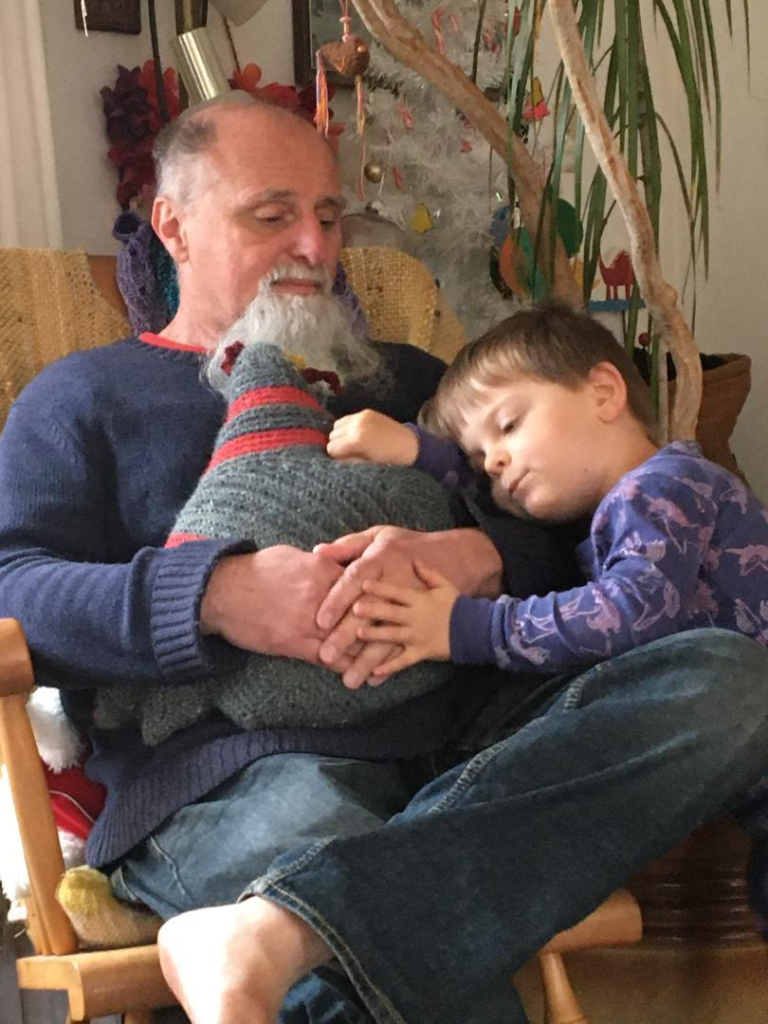
I’ve been a fulltime caregiver for one of our grandchildren for over four years now. My wife and I have been responsible for Asher almost since he got out of the NICU. The thing that is most striking about my relationship with Asher is that I spend more time with him than I ever did with any of our own children. This is mostly due to the fact that I am retired. It is also because Asher does not currently have anyone else to care for him. In many cases grandparents serve as part time babysitters to help out the parents of the grandkids. My wife and I act in place of Asher’s actual parents. For the time being, we are raising our grandson, and we have more time to do so than we did with the previous generation. However, we have far less energy than we did thirty years ago.

My wife and I work in shifts to care for Asher. I am a morning person, so I am active with Asher early in the day. My wife is a night owl, so she takes over after lunchtime. I am in the habit of going places with Asher, usually to a playground or a library. That gives my wife a chance to catch up on her household chores or work on her fiber arts or just relax and enjoy some quiet time. Asher and I are together almost every day for three to five hours, just him and me. We play, we talk, we eat, and we argue. We bond, and we do that in a way that I have never done with a four-year-old. I am his grandpa, but also more than that, and he is more than just a grandson to me.

Yesterday, the two of us went sightseeing. We drove a few miles south to the Eco Justice Center. It’s a small farm and also a place for environmental studies. Asher always notices when we are getting close to the farm because he sees the blades of the wind turbine turning in the breeze. The farm has chicken, goats, and alpacas. Asher likes to visit the alpacas. He keeps calling them llamas. Well, he’s close to being right.

The people running the farm also have a few guinea hens. Those are fiercely territorial creatures. They apparently like to defend their turf from small children. Asher is a small child, and they confronted him. He ran from two of them, which encouraged their aggressive behavior. One of them nipped at his blue jeans. He freaked out. I told Asher,

“Don’t run. Walk slowly to our car.”

He moved away from the guinea hens at a glacial pace while keeping an eye on them. He asked me,

“Grandpa, is this slow enough?”

“Yeah. However, we need to get to the car sometime. You can go a little faster.”

We left the farm and drove a little way to the lighthouse at Wind Point. The lighthouse sits close to the shoreline of Lake Michigan north of Racine. Asher was excited about going to the beach. The water was cold, and the wind was kicking up breakers that churned the surf into a greyish brown color. Asher had on his rain boots because I knew he would play in the surf. He found a mound of tiny shells. He picked one up and put it to his ear. He told me,

“Grandpa, I can hear the ocean!”

Most of the beach was covered with brownish sand, but there was also a low-lying ledge of limestone that was filled with hollows that served as tidal pools. Asher launched small round stones into the pools. The rocks were of different colors: black or white or deep red. As he threw the stones, he kept moving further into the water.

I yelled at him, “Don’t go in too deep! I don’t want you to get water in your boots!”

“But Grandpa! I am not going too deep! Can’t you see?”

Note: Asher’s favorite word is “but”. Most responses I receive from Asher start with that word.

Later, Asher grew weary of throwing stones into the lake. He insisted on climbing the large rocks inland from the beach. He was clambering up them from the shore toward the lighthouse. That worried me. I kept imagining him slipping and doing a lip stand. I told him,

“Get off the rocks! I don’t want you to get hurt!”

He kept climbing over the boulders. As he navigated the rocks, he replied,

“I can do this! See! I am on the other side now! I didn’t get hurt! I am on the main island now!”

The “main island”? The “mainland”? Whatever. He was on a level grassy area inland from the rocks. He asked me, “Grandpa, what is this place?”

“Asher, this is a golf course.”

The answer meant nothing to him. We got back into the car and drove to his favorite playground.

The day was getting warmer, and the playground was packed with youngsters. I prefer to visit the playground when it is not so busy. The more kids there are, the higher the energy level. As the population increases, the volume goes up. The children move faster and confusion reigns. Often, caregivers at the playground have their eyes glued to their smart phones. When the place swarms with children, everyone’s radar is focused on their young charges. It’s easy to lose a kid in the crowd.

Asher was running around like all his contemporaries. I kept moving with him. I got tired. Being hyper-vigilant is exhausting. Finally, I told him it was time to go home. He balked at this idea. After much haggling, he got into his car seat.

On the way home I rolled through a yellow light. Asher noticed. He told me in all seriousness,

“Grandpa, a yellow light means that you should slow down and stop.”

I said, “Thanks, Asher. I’ll do that next time.”

He fell asleep after that.

Writing Letters

April 5th, 2025

A friend of mine is in jail. The odds are good that he will go to prison. Keeping in contact with him is difficult. There are certain times when he can call me, but I can’t call him. He probably has no access to the Internet, so emails, texts, and social media are out of the question. That only leaves the slow and archaic practice of writing snail mail letters to each other. That’s what we do, and that’s probably what we will have to do for the foreseeable future.

I like to write letters. I am aware that many people do not. I have children who aren’t sure how to use a postage stamp. However, the ability to communicate with pen and paper still comes in handy at times. Over the years, I have written letters to numerous people who were not able to interact with others except through the postal service. Some of these individuals were in nursing homes, some were deployed overseas with the military, and some were incarcerated. In a world where many, if not most people, can reach out to another person anywhere at any time, there is a population that for variety of reasons is isolated from the rest of humanity, and they depend on actual, physical letters.

My father spent his last years in a nursing home. He lived about three hours away from me, so my visits were infrequent. He wasn’t much interested in talking on the phone, and honestly neither was I. I don’t think he ever learned how to use a computer. So, I wrote letters to him, every week. I just told him about how things were in our family. Writing helped me to organize my thoughts and express them clearly. He never wrote back. Not once.

One time, during a visit with him, my dad made a point of telling me how much he appreciated those letters. Even though he did not write back (he hated to write), he was always pleased to receive mail from me. Those letters were our connection, albeit tenuous and one-sided. It’s all we had.

Several years ago, I wrote letters to a young man from our neighborhood who had joined the Marines. I wrote to him while he was in basic training at the base in San Diego. He wrote back. We corresponded until he was out of boot camp. Then he lost interest in my letters. I understand that. He was busy having adventures. However, my letters might have helped him to make it through basic training. They let him know that somebody on the outside cared about him. I know that during my first year at West Point, letters from friends and family kept me going. Those letters were like gold.

I have often written to people in jail or prison. I guess I hang out with a bad crowd. Anyway, I have written to people who were incarcerated to serious crimes, and I have written to people who did time for civil disobedience. The folks who were in jail or prison for CD broke the law as a matter of conscience. They committed a crime because of their religious and/or political beliefs. They were usually antiwar activists. Hell, I went to jail for civil disobedience. I was in for only a day, but I got some small understanding of how it feels to be on the inside. It’s a lonely place.

One incarcerated person told me that other inmates were envious of her because she received a lot of mail, while other prisoners did not. I can see that. When a person is isolated from society, they can easily feel forgotten, and sometimes they are right about that. Some people in prison or nursing homes never get letters. It is like they no longer exist. If a person feels that alone, it can destroy them. Humans need companionship. They need to be needed.

So, I write letters.

A Sudden Jolt

March 30th, 2025

I woke up tired this morning, like I do most mornings. Some of the fatigue is simply due to me getting older. Some of it is due to being a fulltime caregiver for a four-year-old boy. Raising our grandson, Asher, can be exhausting. In any case, I was dragging when I got up, and caffeine was of no help to me. Sometimes, coffee is a stimulant. Sometimes, it’s just a diuretic.

I would have liked to just slouch through the day, but seeing it was a Sunday, my wife and I needed to go with Asher to church. Taking Asher to Mass can be fraught with peril. Generally, he is well-behaved, at least for a four-year-old he is. Asher is well liked at church. The congregants all know him by name, and they are fond of him. However, there are times when Asher is moody and restless. He can be loud and demanding. He will often just leave the pew and wander about the church. Nobody seems to mind him doing that, but either Karin or I have to be vigilant. He’s been known to splash around in the baptismal font.

In addition to being responsible for the surveillance of Asher, I also needed to perform the duties of a eucharistic minister. To give a brief explanation, I have to mention that part of the liturgy, actually the most important part of the service, is when the priest transforms bread and wine into the Body and Blood of Christ. The wafers of unleavened bread and the wine are still physically the same after the transformation. However, Catholics (and some other Christian denominations) believe that these things are profoundly changed. The priest, and sometimes a deacon, give the communion to the assembled congregants. Eucharistic ministers assist them with the distribution of communion. That’s what I was going to do.

Distributing communion is not a difficult task. All I was required to do is stand before of a long line of worshipers, hold up a wafer, and say, “The Body of Christ”. Then I would hand the wafer to the person in front of me, who would then promptly place it in his or her mouth. It can be like a religious assembly line. I expected that it would be that way for me.

It wasn’t.

As the first-person stepped-up to me, I held up the host, looked the individual in the eye, and said, “The Body of Christ”. As soon as I spoke, I felt something akin to an electrical shock running through my body. I stood there stunned because I was suddenly aware that the person receiving the communion was also the Body of Christ. And so was I. And so was the priest. And so was my Muslim friend who is celebrating Eid al-Fitr today. And so is my elderly Jewish friend who wants me to take him to a synagogue.

So is everybody and everything.

Then Asher yelled at me, “I don’t want you doing that!”

He gave no reason why he didn’t want to hand out communion, but Asher was adamant that I should stop. Asher came up to and gave me a shove. Karin got up from the pew and dragged him back there. Asher was inconsolable at that point. He wanted me to be with him. He almost always wants me to be with him.

I snapped out of my reverie and continued to distribute the hosts. I still had the same feeling as before what it wasn’t as intense. I wanted to cry.

When I had finished my work, I went back to the pew and picked up Asher. He wanted me to hold him. He sniffled and said, “I didn’t want you to do that.”

I whispered to him, “I don’t have to do it anymore.”

I sat down with Asher in arms. His head was resting on my right shoulder. I thought for a while. “Asher” means “Happy” in Hebrew. The name fits him. He usually is happy. In some mysterious way Asher is connected with the Jewish tradition along with being a baptized Catholic.

I started saying a Hebrew prayer to myself as he clung to me.

“Barukh atah Adonai Eloheinu, me’lech ha’olam…

“Blessed be the Lord our God, King of the Universe…”

That’s all I know of the prayer. It was enough.

A Visit

March 28th, 2025

I took Asher to visit the old man and his wife. The term “old man” is relative. Many people would consider me to be an old man, but the person we went to see is old enough to be my father. I think he is 91 years old now. He is in excellent shape. His mind is sharp and his body functions pretty well. I would be thrilled to be as spry as he is when I get that old, if I get that old.

I know the man and his wife from our old synagogue. We don’t go there anymore because the shul is no longer in existence. For years, the population of the synagogue declined until there weren’t enough men to form a minyan (a minyan is ten adult Jewish males). I hadn’t seen this couple for almost three months, not since the synagogue closed its doors. The congregation dispersed, and now we are spiritually homeless. It takes time to find a new place to pray.

The old man and his wife are immigrants from Ukraine. They left there when the Soviet Union imploded. The old guy grew up in Stalinist Russia. When he was a boy, not much older than Asher, he and his grandfather had to flee to Kazakhstan to avoid the Nazi invasion. Both of his parents were officers in the Soviet Army during WWII. His family suffered intense antisemitism in Ukraine, despite the fact that his mother and father fought for their country. His son was also an officer in the Soviet Army. The son fought in Afghanistan and was severely wounded. The old man and his wife buried their boy two years ago. I was there at the funeral.

The old man and his wife love Asher dearly. What’s there not to love? Asher is an amiable four-year-old. He’s smart and articulate. The elderly couple has been asking me to bring Asher for a visit for months. We finally got around to it yesterday.

The old man thinks Asher is a nice Jewish boy. My grandson does have a Hebrew name. The old guy is convinced I’m Jewish. In his mind, if I am his friend, I have to be. I love the man, so at least for him, I am Jewish.

The couple live in an apartment complex in downtown Milwaukee. The old man greeted us at the door and led us to their tiny home. It’s a bit cluttered, but then so is my house. A person accumulates many things during the course of a long life. Most of the articles scattered around the apartment were memory aids. On the bookcase is a black and white photo of their son in his Soviet Army uniform. There is a small Israeli flag. Near the television is a glass paperweight engraved with the Star of David, the image of a Torah scroll, and a menorah. The small table is littered with mail and other documents. Books in Russian and Ukrainian line a shelf. Bottles filled with prescription meds are laying around in seemingly random locations.

The old man sat down on the couch and started talking with Asher. He spoke with a strong Slavic accent. I took off Asher’s coat and told him to show the man his new sweater. The man asked him,

“Who made for you this nice sweater?”

Asher smiled and answered, “Oma made it.”

“Oma? She has a knitting machine? Yes?”

I replied, “No, my wife, Karin, did it all by hand.”

The old guy exclaimed, “All by hand? It is wonderful. It must have taken a long time.”

Asher told him proudly, “It’s got elephants on it.”

The man laughed. “It does!”

His wife prepared something for us to eat. She brought out a box of small donuts for Asher. Her hands shook as she placed them on the table after shoving the papers aside. He took one and started to eat it. She went back into the kitchenette and pulled a bottle of apple juice from the refrigerator. She had to ask her husband to open it. Her hands and wrists are weak. She painstakingly poured the juice into a cup and gave it to Asher. I told him to be careful not to spill it. He held the cup with both hands as he sipped the juice.

I sat and talked with the old man. His wife came out with homemade bread and cheese. She cut an avocado in half for us. She gave Asher a large bowl of strawberries. He ate as many as he could. She did not talk very much to us. Even after thirty years, her English is not the best. She struggles to find the right words.

The man asked Asher to recite the alphabet. Asher got as far as “E” and then lost track of the letters. The old guy asked Asher if he would like a small toy car. Asher said he would. Then the man asked him what kind. Asher told him he wanted a monster truck. That confused the man. Finally, Asher told him he would like a dump truck. The old man nodded and smiled at the boy.

The woman brought out glasses for coffee. The glasses contained steaming hot water, and she gave us instant coffee to mix with it. The old man poured condensed milk and sugar into his coffee. I drank mine black.

Asher got bored.

He told me, “I want to go home.”

I told him, “We’ll go when I finish my coffee.”

Asher leaned up against me and snuggled.

“But I want to go now.”

‘Wait for me, or I will tell Oma not to let you watch a movie.”

Asher gave me a despairing look and said,

“Nooooo…”

“Yes. Just wait. It won’t take long.”

The old man asked me,

“Have you found a new synagogue?”

“No. Not yet. Ken goes to WITS, but they start the service too early for me to get there on time.”

He replied, “WITS? Wisconsin Institute for Torah Study? I don’t like them too much. They are black hats. Too strict. I want a normal Orthodox shul. I am thinking about going to Chabad. Lubavitch. It is only three blocks from the bus stop.”

I told him, “Let me know if you go. I don’t want to go to a new place alone. I can give you both a ride there.”

He nodded.

Asher got impatient and whiny. I finished my coffee and helped Asher put on his coat. I told him,

“Give them a hug, or maybe a handshake.”

He shook both their hands. They smiled at him.

The old man told me as we walked toward the door,

“I will tell you when I want to go to a new shul. I do not want to go to a new synagogue without you.”

We hugged. Asher waved to them as we left the apartment.

Up on the Watershed

March 23rd, 2025

“And there’s always retrospect
(when you’re looking back)
To light a clearer path
Every five years or so I look back on my life
And I have a good laugh
You start at the top
(start at the top)
Go full circle round
Catch a breeze
Take a spill
But ending up where I started again
Makes me wanna stand still” – from the song Watershed by the Indigo Girls

I had lunch on Wednesday with a good friend, and then I did the same thing with another friend on Friday. In between, on Thursday, I turned sixty-seven years old. I spent both lunches talking about getting old. For some reason that was on my mind.

Both of my friends are older than I am. They have more experience and wisdom. One of them is eighty-three. I mentioned to him that he can’t even see sixty-seven in his review mirror anymore. I talked to my friends about looking back on my life and thinking about stupid things that I had done. They both said that was basically a waste of time, a true rabbit hole There is no point of reviewing old mistakes because all of that is in the past and there isn’t a damn thing that can be done about any of it.

This is of course true. Pondering the past only has value if lessons can be learned that have an impact on the present. The present is all there is: no past, no future, only now. For all three of us, the now is packed solid with responsibilities. There really isn’t time to ruminate on things that might have been. Reminiscing is like a hobby. It’s an activity for people who have time on their hands. My friends and I don’t have that luxury. Our present lives have a full schedule.

My two friends spend a great deal of their time caring for sick spouses. I spend my days (and often my nights) watching over a four-year-old boy. All three of us have a mission to perform. We each have our reasons to get up in the morning and we know that others depend on us. Our lives are sometimes difficult, but we all have a clear purpose. That makes all the difference.

When we meet, we bitch about our struggles, but we wouldn’t think of abandoning our loved ones in their need. We are blessed in an odd way. We know what needs to be done, and we do it. The people I pity are those who seem lost and bored with life. They don’t want to commit to anything or get involved. They exist, but they don’t really live.

Every day we are up on the watershed.

“Up on the watershed
Standing at the fork in the road
You can stand there and agonize
Till your agony’s your heaviest load

You’ll never fly as the crow flies
Get used to a country mile
When you’re learning to face
The path at your pace
Every choice is worth your while” – from Watershed

Flowers

March 25th, 2025

I took my grandson, Asher, to his therapist this morning. I do that every Tuesday. He’s an active and talkative four-year-old whose been through a great deal of trauma in his young life. The therapy seems to be helping him. His sessions last for an hour. I wander around for a while until he gets done. This time I needed to talk to the doctor in charge of the clinic after Asher’s time with the therapist was over. The doctor had to make sure that the credit card I used for a copay went through the system. She wasn’t in the office when I dropped Asher off, so I waited for her to arrive when his session was done.

I didn’t have to wait long. She breezed through the door and into the reception area right after Asher finished his therapy. Dr. A was smiling and she held a bouquet in her hands. She looked at me and said,

“These are for you.”

All I could think to say was, “Oh”, as she handed me the bouquet.

Still smiling, she told me that she and the office manager had wanted to give me something to show how much they appreciated how I cared for Asher. She quipped,

“Men don’t usually get flowers, but we thought they would be okay.”

I replied, ” I have never gotten flowers before in my life.

The office manager, Eli, chuckled. Dr. A went into her office to check on the status of my payment. The therapist took Asher into her room to play until the doctor was finished doing whatever she needed to do. Eli looked at me and said,

“Dr. A and I talked about it. We wanted to get you something to recognize the good job you are doing with Asher.”

I told him, “I’m just doing what needs to be done.”

Elic nodded and smiled. He said,

” I know. It’s organic with you. It’s like second nature. That’s what makes it so amazing. You know what a man should do, and you do it. Not every man does what you do. Some gentlemen leave it to somebody else to do. You step up.”

Dr. A came out to tell me the payment went through with no problem. I went to the therapist’s room to gather up Asher. He looked at the bouquet and said,

“I don’t like those flowers! Don’t take them home!”

I convinced the boy that I should keep them. Actually, I bribed Asher.

When we got home, my wife put them into a vase. Asher didn’t like that either.

When They Come For You

March 25th, 2025

The following letter from me was published by The Capital Times of Madison, Wisconsin, yesterday. See below.

“I can understand why ICE wants to deport violent criminals and gang members. I can even understand the rationale for members of the Trump administration wanting to expel other undocumented people. But why are they starting to deport individuals with green cards and valid visas? I think they are doing this to prove that they can. They want to show that the rules have changed, and no one is safe. Trump’s goal is to frighten people, and he is succeeding. I know I’m scared.”

And so, It Begins

March 24th, 2025

I had lunch yesterday with a young man who works in the construction industry. I asked him,

“Is work slowing down?”

“Yes.”

I asked him why people were getting laid off. He replied that big projects, one of which was supposed to start any day now, were being postponed or cancelled. His take was that this slowdown is due to Trump’s tariffs, especially those on steel. Builders, especially major players, don’t know where to get what they need. They could still purchase steel from overseas manufacturers, but it would cost them significantly more to do so. They may not be able to get the particular product they want from American companies. Also, the builders and those corporations who employ them have no idea if these tariffs are going to stick. Trump’s track record has been confusing and chaotic, so these projects are on hold until there is some stability. There might not ever be any.

The young man commends of the ultimate goal of the tariffs, that being the return of manufacturing to the United States. However, it has taken decades, especially since NAFTA was approved, for American companies to offshore production. It will take years to bring manufacturing back, if it even can come back. In the meantime, supplies chains are being broken and in some cases construction grinds to a halt.

When April 2nd rolls around, and Trump’s next wave of tariffs take effect, other industries will be impacted. An economy that up until now has been running smoothly, will stumble. Consumers, like corporations, will have to pay more or reluctantly switch over to alternative products. People will feel uneasy and buy less. I know that I will buy less.

Do you see a trend here?