Community

November 7th, 2019

“Pull up a chair. Take a taste. Come join us. Life is so endlessly delicious.”
― Ruth Reichl

“No man is an island, entire of itself; every man is a piece of the continent, a part of the main. If a clod be washed away by the sea, Europe is the less, as well as if a promontory were, as well as if a manor of thy friend’s or of thine own were: any man’s death diminishes me, because I am involved in mankind, and therefore never send to know for whom the bells tolls; it tolls for thee.”
― John Donne

During the trip to El Paso/Ciudad Juarez, several people told our group to work at building community. I remember, in particular, Father Bill mentioning that. It sounds like a good idea. The problem is: what does it really mean? How do you build community? What exactly is a community, and why do we want to build it?

One definition of the word “community” is:

“A group of people living in the same place or having a particular characteristic in common”.

That definition doesn’t help very much. It could mean almost anything, and maybe it should.

During one of our evening reflections at Casa Vides, a member of our group remarked that we had already done much to build community among ourselves. Really? How and when did that happen? In the last few weeks, since we returned from El Paso, I have heard from five people who were in our company. That would be five out of fourteen. So, does that make us a community? Perhaps not.

Building community, whatever that actually means, is a long and arduous process. Spending five days together with strangers does not make a community. During the five days, I spent hours talking with some people, and I spent at most five minutes interacting with others. I suspect that this sort of thing is normal. I connected quickly and easily with some folks, but I felt a distinct barrier in my dealings with others.

Building community takes time. A person does not become part of a community overnight. Sometimes, the process requires enormous patience. I am part of a shul, an Orthodox Jewish community. I am not Jewish. I would estimate that it took probably five years before I was accepted into that community. It took that long for mutual trust to develop. This might be an extreme example, but I mention it to emphasize that building community is not as simple as friending somebody on Facebook.

Building community requires listening. To truly connect with somebody, a person has to shut up and listen to other people. In our culture we are not good at that. Often when I talk with someone, my mind has already gone some place else. I find it difficult to be with another person 100%. However, that total commitment is necessary to establish a bond with the other individual.

Building community cannot be forced. Connections between humans happen in a haphazard sort of way. There are environments that are conducive to community-building; for instance, meals taken together. However, communities, like friendships, develop at their own pace. Community building is not always an active process. Sometimes, it requires that people abandon their agenda and just let things flow. Our culture is not good at that either.

People move in and out of communities. A person may be part of a community for just a week, or maybe for their entire life. Communities are fluid. They are dynamic because they are alive. Living things move and change. Only death is static.

Is our small group from the El Paso trip a community? I don’t know. It may be in the process of becoming one. We have shared an important experience, and some of our interests are the same. However, we are, at this point, mostly just strangers to each other. We could easily drift away from each other, and that would be a shame.

I guess we’ll have to work at this.


Borders

November 7th, 2019

“I stand here at your border crossing
What a way to meet
Face in total disarray
Papers incomplete
A traveler at your mercy
My future rests on you
Will you turn me back around
Or will you stamp me through

Please forgive my awkwardness
I know I’m quite a mess
If I were a smuggler
I’d have much more finesse
Yes, if I were a smuggler
I’d breeze across this border
My clothes a bit conservative
My papers all in order

So please do check my pockets
And by all means check my bag
Make sure you search my vehicle
And check the license tag
And when you feel I’ve met
The strict demands of your employer
I hope you find it in your heart
To lose your paranoia”

“Border Crossing” from Timbuk 3

I don’t understand borders. I realize that statement does not make much sense, but it is true.

When I was in El Paso/Ciudad Juarez, the border was in my face all the time. The wall, the river, the bridges, the ports of entry: all these things made it abundantly clear to me that there is (literally) a line in the sand that some people cannot cross.

I don’t understand that. I don’t understand why these things exist.

My wife, Karin, is not a U.S. citizen. She has a green card, and she has resided in the United States for almost thirty-five years. She has chosen to remain a German.

A number of people have asked me about that. It bothers them. They usually ask things like:

“Why doesn’t she want to be an American? This is her home, isn’t it?”

Those questions only make sense if a person assumes that there is actually a difference between being a German and being an American. Karin does not see a difference. Nor do I. Karin and I, being rather Catholic (or occasionally Buddhist), really believe that there is only one human family, and therefore the divisions between peoples are all artificial.

This means that we consider borders to be things that are only man made, which means they can also be unmade. Borders exist first and foremost in our minds. Borders are just ideas, at the beginning. Later, they take on concrete form. Human borders do not exist in nature. The only physical border that can be seen from space is the the Great Wall of China, which is no longer functioning as a border. All borders are ephemeral, and in a sense unreal. Yes, walls of steel and cement are tangible, but they are not natural. History has shown that they do not last.

What else has history shown us? From my reading, history shows a continual migration of peoples across the globe. There has been an endless mixing and movement of populations, regardless of the obstacles placed in their ways. Even in my own lifetime, borders between countries have changed and shifted. The permanence of these boundaries is an illusion. We spend endless amounts of time and money to stop a relentless tide. We fight against our own future.

It was striking to me when I walked over the bridge from Mexico to the United States. I jumped through all the hoops provided by the Custom and Border Protection folks. I showed them my passport, my little magic book. After a quick glance, they waved me through. Other people, they don’t wave through. How do they decide who is worthy, and who is not? Is there an objective standard? I doubt it.

Am I any better than an asylum-seeker from Honduras? No. So, why can I come into the U.S., but that person cannot? Why can I have a home here, and the other person has to sleep in a tent on the other side of the border? In this world, in this age, what does it mean to be a citizen of a certain country? In a time when the free flow of goods, and information, and especially money is paramount, what does it mean to be a citizen of a particular country? When multinational corporations spread their tentacles across the planet, what does it mean to be a citizen of one country?

Who are we?

Are we not one?


Helicopters in the Night

November 3rd, 2019

I never slept well at Casa Vides in El Paso. It wasn’t the fault of anyone there. It’s just how I am. I wake up pre-dawn, and then my mind races for a while. While I was staying at Casa Vides, I would get up and sometimes go outside. I would stand on the upper landing in the cool breeze, and stare at the lights of El Paso. It was usually quiet, except for the sound of the helicopters.

There was always a helicopter in the sky in El Paso. Day or night, there was always somebody flying along the border. That was 24/7; constant, endless surveillance.

While we were in El Paso, we had a meeting with members of the U.S. Border Patrol. They met us on the dirt road that runs parallel to the wall. Four agents got out of an SUV. Three of them were in uniform, and one was in plain clothes. They were all Latinx. I’m not sure why that was. I don’t think it just a coincidence.

The agents explained their work. The Border Patrol monitors the territory in between the official ports of entry. The U.S. Customs and Border Protection folks work the ports of entry. Border Patrol are in green uniforms, and the CBP in blue. The Border Patrol officers have a big job. They usually operate alone, seeing as there aren’t enough agents for them to work as teams. They ride in SUV’s or on ATV’s. Some of them ride horses. Some fly in helicopters.

The Border Patrol has a wide selection of surveillance equipment. They have infrared cameras, seismic ground sensors, and magnetic sensors. They have all of the newest toys.

The agents spent most of their time describing the humanitarian side of their work. At least one of them was an EMT. They do search and rescue missions to help people who are lost in the desert. They catch human traffickers. They stop the “bad guys”, or try to.

I asked one of the agents, “How much of the drug traffic do you manage to stop?”

I didn’t get an answer. The agents told us that was no accurate way of measuring their success rate with regards to drug interdiction. I found that to be interesting.

If these agents are right, then we, the people of the United States, are throwing billions of dollars into a ambiguous fight against the cartels. We have no idea if what we are doing is effective. We have no way of knowing if we are winning the war on drugs. We are just blindly hoping that our efforts are making a difference. I don’t see this is being a good way to operate.

I don’t envy the Border Patrol agents. They seem to be dedicated. However, it appears that they are doing a thankless, and perhaps impossible job. They are trying to hold back a relentless tide of desperate migrants. They also are trying to stop drug cartels that are probably as well equipped as the Border Patrol is.

It’s a bad situation, and the sound of the helicopters remind me of that.

Casa Romero

November 3rd, 2019

Casa Romero is one of the shelters run by Annunciation House in El Paso. It’s larger than Casa Vides, and it is situated in an industrial area. Casa Romero is located close to a detention facility for illegal immigrants that is run by ICE. There is more than a little irony in that. If I remember right, Casa Romero itself was once a detention facility. That is even more ironic.

Our group arrived at Casa Romero around supper time, so we ate with the guests who were staying there. There weren’t very many people staying at Casa Romero, mainly because of the latest rules imposed on migrants by the Department of Homeland Security. A month ago, this place would have been packed with people. Now it was nearly empty. It is very possible that, at any moment, the shelter could be full again. It all depends on the man in the White House, and changes could occur at the speed of a tweet.

Some volunteers served us dinner. We had spaghetti, garlic bread, and a salad. We sat at tables with the guests. I sat across from an elderly Mexican woman. I made a feeble attempt to start a conversation in my extremely limited Spanish, but that really didn’t work out. We could not understand each other, amid the noise at the dinner table.

Most of the people at Casa Romero were older women. They were from Mexico. They reminded me a lot of the ladies in my wife’s knitting group. None of them were typical migrants. None of them planned on living in the United States. Actually, their story was a lot weirder than that of the other guests at Casa Romero.

These elderly women were in El Paso in order to qualify for Social Security benefits. Their husbands, now dead, had worked legally in the United States long enough to entitled these widows to Social Security checks. Our government requires these women to take to extraordinary measures to collect the money that is rightfully theirs. If a widow lives in or near Ciudad Juarez on the border, she is required to show up at an El Paso Social Security office once a month. If the widow lives far from the border, she is required to show up at a Social Security office on a specific date once a year, and then stay in the U.S. for an entire month. Does this make any sense? Of course it doesn’t.

As far as we know, this rule only applies to Mexicans. As an example, I will qualify for Social Security in a few months. If I drop dead, my wife will get a check. My wife is a German national. If, after my demise, she would decide to move back to Germany, I am pretty sure that the Social Security Administration would send her checks to that country. This particular policy seems to be designed to make it difficult, if not impossible, for Mexican widows to get the money that is due to them. I have to admire the old ladies staying for a month at Casa Romero. They are determined to get what is owed to them.

After supper, after we cleaned up the tables and put away the chairs, Brinkley gave us a talk about the detention of illegal immigrants.

That talk was hard for me. Brinkley talked about the government’s policy concerning detention of people who have crossed the southern border illegally. Those who are arrested are almost always placed in detention for an indefinite period of time, without access to friends, family, or legal assistance. This applies even to those persons, or especially to those persons, who are seeking asylum in the United States. Brinkley spoke to us about the innumerable obstacles placed in the path of these detainees. It all sounded way too familiar.

There is a young woman in prison right now. My wife and I love her dearly. Some people in our group seemed shocked and disturbed by Brinkley’s comments. They just don’t know. I understood Brinkley’s words clearly, because I have lived them. Nothing that Brinkley said was new to me. I have seen all of this.

I asked Brinkley directly,

“So, what you are saying is that these detainees are screwed unless they have somebody on the outside to pay for their access to phones and mail and legal representation?”

There was an awkward pause, and then she replied, “Yes.”

It’s true. A prisoner is totally dependent on support from people on the outside who have money. That is not just for migrants. This is for anybody who is incarcerated in this country. A person without a friend on the outside is lost, utterly lost. I know this.

It breaks my heart.

The United States is a cold and cruel country sometimes.

It just is.


Bill, Betty, and Peter

October 30th, 2019

Anapra has some surprises.

A quick tour of Anapra (a poor neighborhood in Juarez) can be instructive. The signs of grinding poverty are obvious. The steel grills on the windows and the razor wire on top of fences indicate that there is crime in the area. It is clear that people struggle to survive in Anapra. There are rumors of violence, although I didn’t witness any. It is a place where I would not want to be alone, especially at night.

Is there anything good in Anapra? Yes. I think the people are good, most of them anyway. We met a few who were truly remarkable.

I am talking about Bill, Betty, and Peter.

Father Bill is the pastor of Corpus Christi parish in Anapra. Our group joined with his congregation for Mass that morning, and then Father Bill took some time to speak with us. He took us to a church hall/community center near the church. The small building had one door with multiple locks on it. After Father Bill opened the place up, we all grabbed folding chairs and sat in a circle. Father Bill started talking.

Father Bill is a Columban priest, and he has been at Corpus Christi for quite a while. He has an interesting history, that includes a stint in the Navy during the Vietnam War. His life is one of change and conversion. He’s had a hard road.

He is a man of faith who is also brutally realistic. He spoke to us about the poverty in the area. He talked about the factories that have been set up by American corporations to take advantage of the cheap labor. Some of the maquiladoras only pay the workers $2.00 a day. It is pure exploitation. Father Bill made it abundantly clear that we, as Americans, bear a great deal of the blame for the terrible conditions in Mexico. It’s hard to listen to a prophetic voice, and Father Bill has one.

The problem with listening to Father Bill describe the desperation of the people in Anapra is that there seems to be no solution, at least not on an individual level. I finally asked him,

“Okay, so what do I do. When I walk out of this door, when I go back home to Wisconsin, what am I supposed to do?”

Father Bill said, “You need to do interior work first. Get connected with God. If you do that, then at least one person is thinking straight. You need to build community. We have community here. People are poor, but we have community.”

Father Bill didn’t have many specific suggestions, but then how could he? I have to find my own path. So does everyone else.

Later, we drove to Casa Tabor. It’s a Catholic Worker house in Juarez. Betty and Peter live there.

Father Peter and Sister Betty invited us into their home. It’s basically a shack. The ceiling is low with the wooden beams exposed. There is a tiny cooking area that connects to a living room of sorts. Both Betty and Peter have bedrooms. Father Peter shares his bedroom with Brother David, who is a chaplain for the El Paso detention center. Sister Betty’s room also doubles as a guest room. They have indigenous artwork in their living room, along with a crucifix on the wall. The house is simple, clean, and welcoming.

We all sat in a tight circle. Father Peter had a notepad on his knee. He wanted each of us to tell our story. So, we did. Father Peter took notes as we spoke. Peter is a bit deaf, so sometimes we had to repeat ourselves. I mentioned to him that I had once been an Army helicopter pilot. He found that to be interesting, and he wrote it down on his pad.

Sister Betty smiled at us, pointed at Father Peter, and asked,

“How old do you think he is?”

Somebody guessed, “Seventy.”

Sister Betty laughed, “He’s ninety-six.”

That dumbfounded me. I would never have thought the man was that old. I don’t expect to look that good at the age of ninety-six. Actually, I expect to look quite dead.

Betty is a Sister of Mercy, and Peter is a Carmelite. They worked together in Peru back in the 1960’s. They started Tabor House in Washington, D.C., in 1973. They moved to Juarez in 1995. They have held workshops for women since 1996. From 2007 to 2012 there was intense gang violence in Juarez. In their area, four people were killed each day. Betty and Peter have been busy. They serve their neighbors. They build community.

Sister Betty has a shrine behind their small home. The shrine is a memorial to the people in Juarez who have been murdered over the years. Some of them were journalists, some were lawyers, some were just ordinary folks. She has the names written on a wall, hundreds and hundreds of them. Each of us picked up piece of paper with a name written on it. We were each supposed to write the name on the wall, and then pray for this victim of violence. It is ritual that Sister Betty uses to remember the dead.

Before we left, Father Peter spoke to me. He put his hand on my shoulder.

“So, you flew helicopters in the Army?”

“Yeah.” I felt uncomfortable talking to him about it, because he was so obviously a man of peace.

“How did you like it?”

I smiled sheepishly. “Mostly, it was fun. Once in a while, it was scary as hell.”

Father Peter smiled back at me, “I was a fighter pilot in World War II. During the war, they told us to fly wild. Then after that, they started have all these rules. That’s when I got out.”

I really like Bill, Betty, and Peter.


Mount Cristo Rey

October 29th, 2019

The visit to this section of the border was intensely Catholic. Fortunately, I have a lot of experience being Catholic, so it wasn’t that much of a culture shock.

Mount Cristo Rey straddles the U.S./Mexican border. It was one of the few places near El Paso that does not have a wall. The only reason it doesn’t have a wall is that it would require far too much effort, time, and money to construct such a thing. The mountain itself is a nearly insurmountable obstacle, so why bother?

Our group walked up the long, dusty road to the crucifix that crowns Cristo Rey. Along the way to the summit, there are the fourteen stations of the cross. Each station is marked by a bright blue cross. At every station we gathered to pray. We prayed for the migrants, whose current sufferings match those of Jesus during his passion.

The mountain is of a conical shape. The path to the peak wound around the mountain, and consisted of various curves and switchbacks. The path was wide enough for two people to walk side-by-side, but there was no guardrail on the way. Often, our journey took us to the side of a cliff, and we prayed together on the edge of a precipice.

Our route took us to places where we could see for “miles and miles” (my apologies to The Who). From up high, I could see the cities of El Paso and Ciudad Jaurez, in all their glory. I could also see the Rio Grande, wandering sluggishly through farm land and urban areas. I saw the wall, as it stretched from El Paso into the distance on the border between Mexico and New Mexico. I could see it all.

I was not at peace.

I was not at peace because I felt alone. The one person that matters most was not with me. Yes, I had friends with me, but Karin not with me. Karin is my partner, my wife. She is also an immigrant. She has a green card, but she refuses to become an American. Everything that I saw, everything that I heard, everything that I felt: she would have understood.

As I walked along the trail, I sometimes felt a little dizzy or unsure of my next step. I wanted so much to hold Karin’s hand. I wanted her to steady me. I wanted her to be there.

Why wasn’t she there?

Karin was not with me out of fear. It was not just her fear. It was also mine. We were worried about her crossing the border into Mexico. She could have come with me to Cristo Rey, but she wasn’t going to go to Juarez. So, she stayed home. Karin has been in this country legally for almost thirty-five years. We have done everything right in order to keep her safe. But, under the current regime, is that good enough? Is anything good enough?

I missed Karin. I wanted to tell her my thoughts and feelings. I wanted to walk down that path, holding her hand as tightly as I could. She would have been with me. What else would have mattered?

Cristo Rey. Christ the King.

What does that really mean?

To me, it means that my wife loves me, even when she is 1400 miles away. It means that I have to care about people, even when l am far away from them.

Cristo Rey means that I have to give a damn.


It’s Cold Outside

October 31st, 2019

It’s been snowing here for hours. This might be expected, and be appropriate, in early December. But it’s not December. Today is Halloween. This is ridiculous.

At least I am prepared for this weather. I know to put on my insulated jean jacket, and I know where to find my warm gloves. I know to sort through the overflowing basket of scarves and knit caps that Karin had made over the last three decades. I can make myself warm enough to brave the snow and wind.

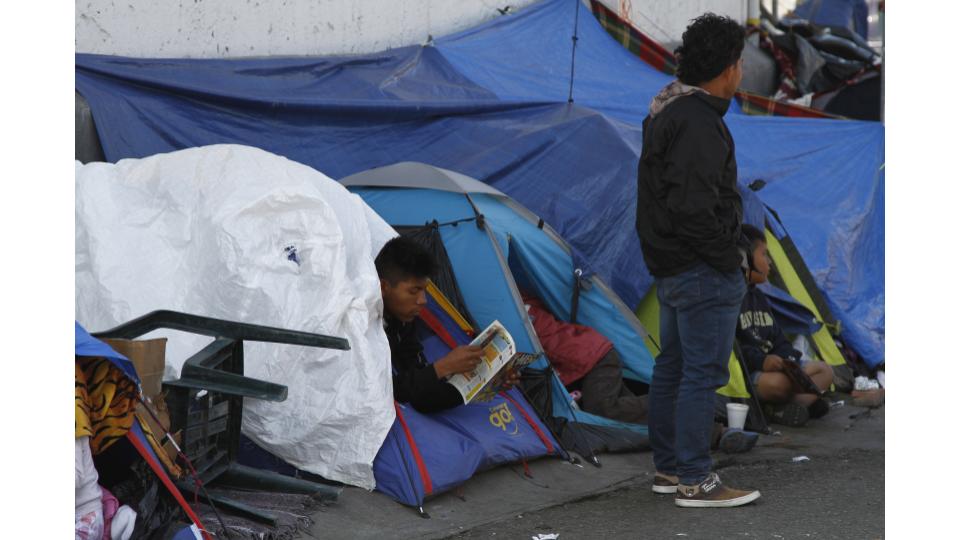
Other people cannot do this. I think in particular about the folks who are living in tents in Ciudad Juarez, on the U.S./Mexican border. I live in Wisconsin, so I expect to be cold for most of the year. The street people who stay near the ports of entry in Mexico have no understanding of cold weather. They all come from tropical climates. They are totally unprepared to live in a tent when the temperature dips down to 39 degrees (as it will tonight). These migrants do not have warm clothes, nor do they have a warm shelter.

I will grant you that their situation is not nearly as extreme as homeless people in Milwaukee. During the winter, our temperatures dive down into the minus teens, or lower. We have life-threatening cold in our city. People die here from the cold. On the other hand, we are all used to this sort of climate. The people who are stranded in Juarez have no clue. They don’t know how to adapt.

So, what will these people do? They don’t have warm clothes to survive through a cold winter. They don’t even have the money to buy the clothes that they would need to make it. Do they stay and freeze in the dark? Do they leave and return to Central America, where they can be murdered by the gangs in a warmer climate? What do they do?

I am very aware that I have it made. I have a nice house, with heat. I have a full refrigerator. I do not fear a knock at the door in the middle of the night. I live a life that most of the people in the tents would envy.  I know that.

I lack only a clear conscience.

I wish that I could save these migrants. Alone, I can’t.

I can do a few things to help. Maybe I can do more. I don’t know.

I will do whatever I can, and ask God to do the rest.


You Don’t Belong Here

October 30th, 2019

Ruben Garcia is an impressive man. He has been running Annunciation House (parent organization for Casa Vides, Casa Romero, and Casa de Refugiado in El Paso) for over forty years, so he knows what he’s doing. Ruben sat with our group at a table in the Café Mayapan. He ordered himself an avocado salad, and stared at us for a moment. Then he asked us why we had come from Wisconsin to participate in the Border Awareness Experience. I’m not sure what answers we gave to him, but he did not seem to be impressed.

Ruben responded to us like this:

“YOU DON’T BELONG HERE! You don’t belong on the border! You belong back home in Wisconsin! You let Trump get elected! Why didn’t you do your homework? You need to go home and make sure that Trump, and Pence, get impeached! Failing that, you need to make sure that they do not get re-elected!”

Okay, we love you too.

From there, Ruben launched into a rant. It was a passionate, intelligent sort of rant. He knew his stuff, and he knew how drive home his point.

He told us, “Things here are BAD!”

Like really bad. Like they have never, ever been this bad before.

I was mildly irritated. Having served in the Army, I have been yelled at by professionals. Yeah, I guess we were all just ignorant tourists, but we were trying to do the right thing.

I spoke to Ruben, “Okay, so, I was initially a little shocked by what you said, but you’re right: we don’t belong here. I figured that out when I pulled into the driveway at Casa Vides. However, I had to come here in order to know that I don’t belong here.”

He smiled faintly. He said, “I am sure you all know that what I meant was that you all have work to do back home.”

Yeah.

Ruben had many other things to say to us (in a calmer voice). He spoke about our country’s responsibility to the migrants. Our country keeps the drug trade going. Forty billion dollars a year flows from us to Mexico to pay for illegal drugs. That money pays for a lot of corruption and violence, in Mexico and throughout the rest of Latin America. Our insatiable hunger for drugs has caused this humanitarian disaster.

Ruben gave examples of families fleeing from the gangs and the cartels. Someone asked him if it would help if we told people back home about the personal stories of migrant families. Ruben didn’t think that would necessarily help. He said,

“Justice has to stand on its own feet.”

I think he meant that the abuse of migrants by our government is obvious. Our complicity in their suffering is obvious. If people can’t see all that, then telling them a sob story about a poor migrant family won’t change their minds.

Ruben told us that we shouldn’t have a War on Drugs. We need a War on Addiction. The Border Patrol and the Wall won’t stop the flow of drugs to the north. The market is too big and too lucrative. Ruben said that the emphasis has to be on helping addicts and reducing consumption. If people in America stopped buying smack, coke, and meth, then there would be no market, and there would be no cartels.

Eventually, the discussion ended. we had to go somewhere else to listen to somebody else.

When we left, I noticed that Ruben had barely touched his avocado salad.


Hospitality

October 30th, 2019

“By definition, a government has no conscience; sometimes it has a policy, but nothing more.” – Albert Camus

Sister Ann Catherine and I started our road trip to El Paso on October 16th. We drove, with only a few brief stops, from Milwaukee to Fort Smith, Arkansas. That was twelve solid hours of windshield time. We arrived at St. Scholastica Monastery tired and a little punchy; well, at least I was. Neither of us had ever been to this monastery before, so we looked around for somebody who might know where we were supposed to stay for the night. We stumbled into the convent, and I asked for Sister Kimberly. She was my contact person at the monastery.

Sister Kimberly burst into the room, followed by Sister Regina. Sister Kimberly is the interim administrator of the monastery. She is a tiny woman with a noticeable limp. She also has a brilliant smile, and a positive mood that is contagious. Sister Kimberly has an energy that makes her incandescent. She practically glows.

Sisters Kimberly and Regina asked us to meet across the street at their newly purchased guest house. We did that, and the two sisters showed us around. The guest house is a beautiful building with several bedrooms. Sister Ann Catherine found her space and I claimed mine.

Sister Kimberly gave us a key to the guest house, and she gave us a spare key to the convent, so that we could come to join the community for morning prayer and Mass the next day.

My thoughts turned to business. I asked her,

“Sooooo, when would you like us to pay you for our stay here? You know, for the rooms and for our meals with you all.”

Sister Kimberly smiled at me and said firmly, “You aren’t paying us anything.”

I shrugged and replied, “Okay, but we really should…”

She cut me off, “NO. We sent one of our sisters to the border recently. This is our way of  supporting your ministry.”

There really wasn’t much else to say.

Kimberly smiled again, and said, “See you at dinner!”

Sister Ann Catherine was amazed by all this. She told me,

“What hospitality! They give us the keys to the place, and then they refuse to take our money!”

It was pretty amazing, and it was totally cool. We were complete strangers to these religious sisters, but they trusted us and welcomed us with open arms.

Sister Ann Catherine and I learned about a very different kind of hospitality when we got to the El Paso and the southern border. We found out what kind of welcome migrants and asylum-seekers get from the government of the United States.

Under the guidance of President Trump, the Department of Homeland Security is doing literally everything it can to discourage migrants from coming to the United States. A migrant, arriving at a legal port of entry and seeking asylum in our country, is subjected to “metering” at the border, meaning they have to take number (like they were ordering something from a deli), and then wait to be called. The wait might take weeks or months. If a migrant has the patience and stamina to wait until their number is called, then they are subject to the “migrant protection protocols”, which require the person to remain in Mexico until their asylum case goes before an immigration court. That might mean that the migrant is stuck in Mexico for years. It also means that the migrant has little or no access to legal representation. If the migrant comes into the U.S. illegally (not at a port of entry) and tries to get asylum, they will most likely be held in a detention center (i.e. prison) for an indefinite amount of time.

Finally, it is extremely unlikely, when the migrant’s case finally goes before an immigration judge, that the individual will be allowed to remain in the United States. Immigration judges in the El Paso area have a denial rate of 95%. It is easier to win the lottery than it is to get asylum in the United States.

Do you see a pattern here?

The U.S. government, at this point in time, is doing everything it can to be inhospitable. As Dylan from the Hope Border Institute told us, the policy is all about “deterrence.”

The message to the migrants is: “Go away, and don’t come back.”

This message is problematic for migrants, many of whom are fleeing for their lives. They are often coming from Honduras, Guatamala, or El Salvador, where the gangs have threatened to kill them. These people can’t go home. It hard for them to stay in Mexico. They have no money, no jobs, and no friends in Mexico. Ciudad Juarez is a dangerous place to be. The city has ten murders a day.

The current immigration policy of the United States is cruel and cynical. It is also potentially deadly for these migrants.

It’s hard for me not to be angry as I write all this down. However, I know there are good people helping migrants on both sides of the border. At Casa Vides and at Casa Romero we saw migrants being welcomed. These people were given food, clothes, and shelter. Most of all, they are given love and respect.

They were shown hospitality.


A City Divided

October 28th, 2019

I went to Berlin once. That was back in 1982, and I was still in the Army. The Cold War was going strong, and the Wall still split Berlin into two halves. I only spent a couple days there. I stayed with a friend of a friend in West Berlin. I also managed to visit the Soviet sector. I went through Checkpoint Charlie. Needless to say, that was an interesting experience.

Last week I was with a group of Catholic migrant advocates in El Paso/Ciudad Juarez. We went across the border between the U.S. and Mexico four times during our visit. We saw the steel wall that divides the communities from each other. While I was there, I started thinking about Berlin, for the first time in a long time. I started to remember things.

El Paso and Juarez started out centuries ago as a single settlement, El Paso del Norte. Even now, after history and politics have separated the the population into two communities, El Paso and Juarez remain deeply connected. There is a constant movement of people and products across the international border. The economies and cultures of the two municipalities are intimately linked. El Paso and Juarez are still, in some respects, a single city, a home to 2.5 million people.

Chris took us to scenic lookout in the mountains on the northern edge of El Paso. From there we could view both El Paso and Ciudad Juarez. The Rio Grande snaked through the center of the urban sprawl. The wall was nearly invisible from our vantage point. To me it all looked like one big city. From a distance I could not see the separation, but I knew it was there.

We visited the Chamizal National Memorial in El Paso. The park is close to the Rio Grande and the Cordova Port of Entry. There is an international bridge that crosses the river. It is used for truck traffic. A line of semis stretched for miles from near the memorial all the way to the bridge. Truckers were waiting for hours to bring their goods into Mexico. The parade of vehicles was an obvious sign of the importance of trade between the U.S. and Mexico. Despite the wall and other barriers, the freight had to flow.

Other things flow across the border. Things like drugs and money. We were told that consumers of illegal drugs in the United States send $40 billion to Mexico annually. Drugs are produced in Mexico, or they flow through the country from other places. These drugs somehow find their way into the U.S. During our visit, our group spoke with members of the U.S. Border Patrol.

I asked one of them, “What percentage of the drug traffic do you think you stop?”

I did not get a straight answer. The officer told us that there was no way of accurately measuring the effectiveness of their interdiction efforts. In short, the Border Patrol has no idea how many drugs are entering the United States. They don’t know how much they are stopping. Apparently, they aren’t stopping enough drugs from coming north, if $40 billion are heading south every year. The money going into Mexico pays for many things: guns, bribes, all sorts of transportation. Walls don’t matter if you have plenty of cash.

So, what do the walls and all the other obstacles on the border between Juarez and El Paso actually stop? Trade, legal or otherwise, is seemingly not affected. Money and merchandise cross with only minor delays. However, people are prevented from coming into the U.S.. Migrants from Guatemala, El Salvador, and Honduras are stopped at the border and denied entry. I’ve seen their tents in the park near one of the ports of entry. Migrants from southern Mexico who are fleeing the violence of the cartels are stuck at the border too.  Why are all these people trapped on one side of a political boundary? It is because they are poor. That’s the bottom line. They have no money, so they have no power, and that makes them unwelcome in our country.

When I was at Checkpoint Charlie in Berlin all those years ago, I visited the museum there. All the exhibits in the place honored the courage and ingenuity of the East Germans who somehow found ways to flee to the West. No matter how much the East German regime tried to keep its citizens on their side of the Wall, a few people always found a path to a better life. I remember how, during the Cold War, we in the West celebrated the bravery of these migrants, and we mourned the those who died trying to cross the border.

For some reason we don’t feel the same way about the migrants trying to cross our border. A person who walks for two months from Guatemala, because he or she fears for their life, and then tries to find asylum in the U.S., is just as brave and motivated as a German fleeing Communist oppression. But we don’t see it that way. We think of the Germans that ran to the West as being heroes. We see the migrants huddled in Ciudad Juarez as being criminals.

Walls don’t work. There is no historical record of a wall halting the movement of people for a significant length of time. The Berlin Wall lasted less than thirty years. It did stop a lot of people, but not all of them. Desperate people can be very inventive and persistent. They will find a way to get to their destination, or they will die trying.

My wife is a German. She has a small piece of concrete sitting on our kitchen counter. It is a piece of the Berlin Wall. It is a souvenir of sorts. It is a physical reminder of the fate of all walls.

Someday, I want to have a chunk of the wall that divides El Paso from Juarez. I would that as a souvenir.