America’s Friends

March 3rd, 2025

This letter of mine was published two days ago in the Capital Times of Madison, Wisconsin. It was also published this morning in the Boston Globe.

Henry Kissinger is said to have quipped, “It may be dangerous to be America’s enemy, but to be America’s friend is fatal.”

During Kissinger’s time as secretary of state, the people of South Vietnam found that statement that to be true. Since then, the Afghans have learned that lesson the hard way.

It seems like the Ukrainians will also discover that Kissinger was right.

When They Get Sent Away

February 27th, 2025

I have a friend, a former coworker, who has a nephew in prison. The nephew is doing ten years for killing a person while driving drunk. My friend told me that the nephew’s father, who is in his seventies, is worried that he might not be alive when his son finally gets released. I thought about that. The father has a legitimate concern. He can visit his son once in a while, but he may never have a close relationship with his boy again.

I have another friend. This man did sixteen years in prison for shooting at a cop. He has kids, but he never got to see them grow up. They had a father who was absent from the most important years of their lives. They were raised by other people.

I know a young woman who is going to prison. She has a small child. She will miss seeing him start kindergarten, along with missing other milestones of his life. They will be able to exchange snail mail and have video calls, but the boy won’t see his mama very often. She won’t be able to care for her child. Someone else has to do that.

Should people like the three I mentioned go to prison? Probably. Do they need to be isolated from the society at large? Yes, at least for a while. Is there a better way to deal with them?

I don’t know.

In our country, we like to talk about a “war on crime”. That’s an interesting metaphor. Our criminal justice system focuses on public safety, which is as it should be. The system also tries, at least sometimes, to give victims of crimes some closure and recompense. However, the system is more about retribution as a form of deterrence than it is about restoration and healing the wounded community. We look at the situation as a war and we fight it that way.

If we are in a war against crime, then there are noncombatants, just like in any other kind of war. If there are noncombatants, then there is often collateral damage. People who had nothing to do with the crime suffer because they are somehow related to the perpetrator. These people can be parents, children, spouses or friends. They have done nothing wrong, but they will be punished just like the person who committed the offense.

Is justice really justice if innocents suffer along with the guilty?

Rock

February 25th. 2025

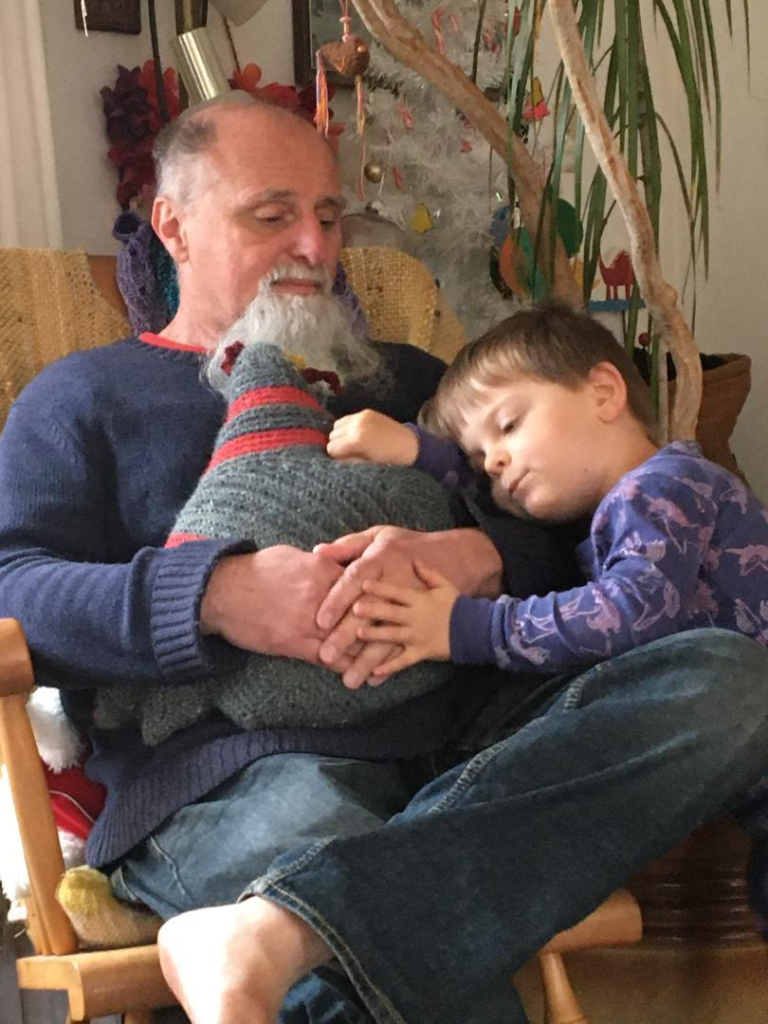
Our little grandson, Asher, wanted me to hold him. I bent over and held out my hands. He let me grab him and pull him up. Asher wrapped his arms around my shoulders and smiled.

My wife, Karin, was sitting on the couch. She smiled too and said,

“Grandpa is always Asher’s favorite.”

There seemed to be just a touch of envy in her voice. I had never noticed that I was Asher’s favorite. My impression was that Asher gave his affection equally to whomever was willing to satisfy his needs or wants.

I asked Karin, “Why am I his favorite?”

She said matter-of-factly, “Because you’re his rock.”

“I’m what?”

“You’re his rock. That’s what people say about you.”

Apparently, I am oblivious to what people say about me, because I found it surprising to hear that. Since that brief conversation a few days ago, I have been pondering what it means to be Asher’s rock.

There is an old song by Paul Simon titled, ‘I am a Rock”. The lyrics of the song describe a person who has withdrawn from society and has made himself impervious to emotional suffering. The last verses of the song say,”

“And a rock feels no pain. And an island never cries.”

I don’t think that is kind of rock my wife meant. However, I have in fact been that kind of person. The song was a touchstone for me in my teenage years, and following the suggestion of Pink Floyd, I spent many years “comfortably numb”. Some rocks don’t feel. Karin wasn’t referring to that sort of rock.

I believe that my wife and others think that Asher trusts me. They see that I supply Asher with security. I am there for him, and he knows that.

Many years ago, I volunteered with a program that tried to help families with troubled teenagers. During each cycle of the program, we spent one entire session discussing the topic of trust. In other sessions we tried to teach communication skills and other ways for family members to work out their problems. However, none of those things mattered unless the people in the family trusted each other. Trust was absolutely crucial, and it was often completely absent. Parents might not trust their teenager because the son or daughter is an addict. A son might not trust the father who had abandoned him. A daughter might not trust a mother who is manipulative. A husband or wife might not trust the partner that betrayed them. Without trust there is no way forward.

We used to do a group exercise called the Trust Wheel. Each person would draw a picture of a wheel with themselves as the hub of the wheel and the spokes representing the individuals who they trusted. We would discuss each drawing, and the artist would explain why they trusted certain people and how much they trusted them. Some wheels had very few spokes.

I know from experience that I can love a person deeply and not trust them any further than I can throw a refrigerator. Love and trust are not the same things. Love can be enduring regardless of a person’s actions. Trust is a terribly fragile relationship that requires constant maintenance. Trust has to be nurtured with thousands of small acts of honesty and dependability. However, trust can be destroyed in a moment. All that is required is a single act of betrayal. Ask anybody whose partner has cheated on them. It is nearly impossible for that trust to be rebuilt.

Asher trusts me. He knows that I will be there when he goes to sleep, and I will be there when he awakes. He knows that I will keep him safe. The two of us fight at times, but he knows that I won’t turn my back on him. This is vitally important for a four-year-old, and probably for anybody else. He needs a rock in his life, and for now I am it.

When Art Hurts

February 21st, 2025

Examination rooms in hospitals are all pretty much the same. The room where the three of us sat looked just like the rooms at other ERs. Asher wanted to know what everything was. He pointed out a thing that looked like a balloon attached to a plastic tube. Karin explained to him that it was there to give a patient oxygen if they needed it. He asked about the boxes of blue latex gloves. Karin told him that the people working in the hospital wore the gloves sometimes. He pointed to one of the boxes and said,

“There is LX on the box.”

Karin told him, “That’s for ‘extra-large’ gloves. You read the letters as ‘XL’.”

Asher replied with the unshakeable confidence of a four-year-old, “No, it’s LX.”

Karin corrected him, “You are reading the letters backward.”

Asher insisted, “It’s LX.”

Karin glanced at me. I said, “Maybe he’s used to reading Hebrew.”

Karin gave me a weak smile and then grimaced from pain in her neck and left shoulder. We were at the urgent care facility because she was hurting. She had noticed the pain in the shoulder the day before, but she had tried to ignore it. She had taken an Advil and used some ice, but the pain got worse. It hurt when she moved her arm. It hurt when she turned her head. It hurt when she coughed. Finally, it just hurt too much, and suddenly we decided to take a ride to the hospital. Karin really did not want to go. Doctors and PAs have a habit of telling patients things they don’t want to hear. Karin was afraid of what she might hear.

The PA ordered some x-rays. She had asked Karin about the pain. The pain and numbness extended from her neck down to her left hand. The PA asked Karin if she had any idea what caused it. Karin had a clue about that. Two days prior she had been feverishly working to complete a sweater for Asher. The sweater had intricate patterns and required tight knitting. To do the work Karin had spent hours holding her shoulders stiff in order to get the handwork just right. She admitted to the PA that she might have overdone it.

The x-rays showed quite a bit of arthritis in and around the shoulder joint. There was inflammation. The trapezius muscle was tight as a snare drum.

The PA prescribed pain meds and a lidocaine patch for the shoulder. The PA also suggested a muscle relaxer, but the side effects sounded way too interesting. Karin is going to get a call in the near future about starting physical therapy to help with the pain and stiffness. The PA told Karin to pause frequently while knitting. She might as well have suggested that Karin take periodic breaks from breathing.

I have been reading “My Name is Asher Lev” from Chaim Potok. The book is about a young Hasidic Jew who cannot stop drawing. He is a gifted painter who struggles with his talent. The story eloquently describes the intensity and passion of an artist. For Asher Lev painting is not a hobby. It is his life.

Karin is a true artist. Her fiber arts are an integral part of her being. She has been knitting for probably sixty years. She also likes to crochet, weave, dye, and spin. Karin is almost constantly working with her hands. She is endlessly creative. She attempts new projects to challenge herself. She experiments with new techniques, new colors, new textures. Her art keeps her young in mind and spirit.

However, her body is getting older. This not the first time that her hands or arms have registered a complaint. She has to pace herself in order to do what she loves.

This is hard.

Hobbies

February 16th, 2025

I received a brief but heartfelt email yesterday from an old friend and West Point classmate. The first sentence was striking. He wrote:

“I’m sure I’m not alone in worrying about you.”

Based on my experience, that is often the first comment of a person preparing to stage some kind of drug intervention. I find it shocking that somebody would actually say that. I guess it never occurs to me that there are people who worry about me.

My friend is aware that I have a lot going on. There are numerous stresses and ongoing crises in my life that test my patience and endurance. At times they seem overwhelming, but I muddle through them. I’m not in danger of a meltdown, but I can see how others could be concerned that I might have one.

Then he wrote, “I’m not trying to be flippant, but is there a hobby or activity that brings you pure happiness?”

That’s a good question, but it made me laugh. Hobbies? Seriously? The mention of a hobby implies that I now have copious free time available to me in my retirement years. It’s like I’m bored and want to take up pottery or golf. I know that my friend is aware that my wife and I are the fulltime caregivers for our four-year-old grandson. That means we do not have much free time at all. Karin and I haven’t had a day off from watching Asher in the last four years, and that is probably not going to change any time soon.

He also asked, “Do you have something that brings joy to you?”

That is another good question, and I take that one seriously. The truth is that caring for Asher, while often a hassle, brings me joy. It really does. He is an intelligent lad and possesses a youthful energy and innocence that I lost decades ago. He is generally fun to be with, and I don’t know what I would do if Asher were suddenly not part of my life. Raising Asher is not a hobby. I can’t just stop caring for him and then go back to that work when it is convenient to me. Raising the boy is a vocation. It is a calling. To put it into military terms, it is my mission. Yet, it gives me a sense of purpose and often joy.

If I in fact have a hobby, it is writing, what I am doing this very minute. Writing is something that is a creative outlet for me, and I can squeeze it in during those brief periods of time when Asher is not making insatiable demands upon me. I write to process experience and express my thoughts and feelings. I post these essays in the hopes that somebody, anybody, will find them useful. It is not an entirely selfish activity. I am gratified if I learn that something I wrote resonates somehow with another person.

My wife, Karin, takes refuge in her fiber arts: knitting, weaving, crocheting, spinning, dyeing. She has told me that her handwork keeps her sane. She too engages with her “hobby” during those intervals when Asher does not need her. The various types of handwork are her passion. She creates wondrous works of art. She just completed a massive blanket to give to our granddaughter in Texas. It is pink, purple, and white in color. It is filled with images of mushrooms and fairies. It’s gorgeous. Karin never sells her work. She gives everything away. Her talent is her gift, and she freely shares that gift with others.

Are there things we would like to do but cannot, at least at this time? Yes. We would like to travel again. I would like to do volunteer work with migrants and veterans again. Karin would like to take extended classes on weaving again. Those things will have to wait. Asher takes priority.

I don’t want my friend to worry about me. I have my struggles, but I am able to handle them. Sometimes, the struggles are what make life meaningful.

Caregivers

February 9th,2025

I know an elderly woman who was the primary caregiver for her son. Her son suffered from cerebral palsy and paralysis. The young man was often in pain. Yet, he was an artist and apparently a warm, loving individual. This woman took care of her child for decades. Her life revolved around her boy, even when he was grown up. From what she told me, looking after him was sometimes extraordinarily difficult, but also extremely rewarding. She has no regrets about spending so much of her life serving him. She is sad, but only because her son is dead, and she misses him.

I know a couple from the synagogue that I used to attend. They are quite old now, and they spent years caring for their son. Their boy was born about the same time that I was. When I was a helicopter pilot in West Germany in the early 1980’s, their son was an officer in the Soviet Army fighting in Afghanistan. He came back from his war severely wounded and deeply traumatized. The man was a brilliant engineer, but he became an alcoholic who could function only part of the time. As the years went by, his parents spent more and more of their time and money helping him. They would stay with him for months on end, and they were always worried about him having a relapse and ending up in a hospital. They buried their son two years ago. Their only regret is that they couldn’t do more for him. Until the very end, they had hoped he would heal and be well.

I have a friend who is caring for his father. His dad has Alzheimer’s disease, and my friend goes to his parents’ house twice a day to help his mom get his father in and out of bed. The father has increasing difficulty with speech and movement. My friend sees the gradual deterioration in his dad, and it grieves him. He insists on being there for his father, even when it is inconvenient or stressful. He won’t abandon him.

Being a caregiver in our society is common but somehow abnormal. We live in a culture which is relentlessly transactional. The basic question in almost all of our affairs is: “What’s in it for me?” Unless a person is a professional caregiver, like a nurse, there is no tangible reward for helping another person on a continuing basis. Sometimes, the person receiving the care gets well and that can be gratifying. However, often the person who needs the help has a chronic or debilitating condition, and they don’t get better. However, as you can tell from my previous examples, there are people willing to be of service for extended periods of time.

My wife and I are fulltime caregivers for our four-year-old grandson, Asher. We have been in that role since he came home from the hospital’s NICU as an infant. Like many other caregivers, we are watching over our charge 24/7/365. I have had a number of people look at me, shake their heads, and say,

“I couldn’t do what you do. I don’t know how you do it.”

Honestly, I don’t how I do what I do, but I still do it. I firmly believe that nobody knows what they can do for another person until they are confronted with that challenge. Some people can’t be caregivers and some people won’t. Like the other folks I have mentioned, my wife and I chose to care for Asher, and we continue to make that choice.

Is it hard? Hell yeah.

So, why do it?

We do it out of love. That answer probably explains nothing, but that is the only answer. Love is hard to describe. It is not rational. It is not self-serving. It is mysterious and it is powerful, perhaps the most powerful thing in the universe.

When We Were Little

February 12th, 2025

On Monday morning I took our little grandson, Asher, to see his therapist. He goes there once a week. The therapist is highly competent and has a good relationship with Asher. She knows how to handle the boy, and she truly cares about him. Asher is usually loveable and fun to be with. Usually. Occasionally he has a meltdown. He did yesterday when we arrived at the therapist’s office.

Asher has had more than his fair share of trauma is his life. During his four years in the world, he has already been through a lot of chaos and stress. My wife and I have provided almost all of his safety and security. Even so, that has probably not been enough. That is why he is going to a therapist. Asher needs more guidance and support than Karin and I can give him.

Asher often needs things to be done a certain way. I believe that he wants things done in a particular way partly because he just wants to get his way. Little kids are like that, and so are adults. However, he needs stability. He needs structure. Too much change too quickly can freak him out. It’s difficult for me to know when change becomes too hard for him to handle until it is too late.

We were a bit late getting to the therapist’s office. Her place is on the fourth floor of a building, and we have to take the elevator to get there. Generally, Asher and I have the elevator to ourselves, and Asher always pushes the button for the fourth floor. Yesterday that didn’t happen. Two other people needed to go up from the lobby, and an older gentleman pushed the 4th floor button for us. Bad move.

Asher totally lost it. He needed to push that button himself. When we got to the fourth floor, he was screaming and crying and demanding that we take the elevator back to the lobby and start the journey all over again. I refused to do that. We were already where we need to be. I was carrying him, and he struggled to get free so that he could get back on the elevator. Asher was loud. He was loud enough to entice the therapist to come out of her office to find out what was wrong.

The therapist asked us to come into the room she has set up for her work. It is packed with toys, including two teddy bears that are as big as I am. Asher was out of control. He stood between me and the therapist screaming. The clinician tried to sooth him and remind him to use his words. She told him,

“Breathe, Asher. Breathe like you’re blowing a bubble. Remember how we practiced that? Do you want to blow real bubbles with me?”

No. He didn’t want to blow bubbles. There wasn’t much of anything he wanted to do besides lashing out. He spent a couple minutes hitting me. I just let him do it. It didn’t hurt except for that one shot to my groin. The therapist offered to let him hit the teddy bears. That’s what they were for. He didn’t want to hit a stuffed animal. He wanted to hit me.

His anger abated slightly, but Asher was still too upset to talk. He wanted me to hold him. The therapist wanted me out of the room so she could work with Asher. It was extraordinarily difficult for me to leave. Asher was crying and holding on to my right hand for dear life. The therapist gently tried to nudge me out the door. She assured me that Asher would be fine. I finally left, with Asher screaming as I went outside.

The mall is next to the therapist’s building. I walked in there and wandered to a bookstore. I bought a novel and slowly walked back toward the office building.

I thought as I walked. I experienced intense sadness. When Asher had held my hand, I felt like I was him. I could remember how I felt when I was that little. I don’t recall much from my childhood, partly because it was so long ago, but mostly because I don’t want to remember any of it. I have slammed a lot of doors in my mind. I don’t remember hardly any events from when I was little, but I remember emotions. Those stick with me. When I was a little boy, and I was scared or angry, did anybody hold my hand? Did anybody pick me up when I was crying? I don’t know. I don’t think so. I wanted so much to just pick Asher up and hold him until he calmed down, but the therapist needed me to leave so she could do her job. I had to be an adult and do that.

I got back to the office as Asher’s session was ending. The therapist brought him out. She was smiling. He was laughing with her.

Asher was fine.

Afghans and Trump

February 10th, 2025

The following letter from me was published by the Capital Times today. The Capital Times is the main newspaper for Madison, Wisconsin and the surrounding area.

“One of the very first executive orders signed by President Donald Trump was to stop the flow of refugees into the United States.

Included in that population of refugees were a large number of Afghans, people who had been our country’s friends and allies for 20 years. Clearly, Trump has the authority to keep refugees from entering the U.S., but these people at least should be allowed to come here.

It is shameful for America to ban Afghans who sacrificed almost everything to help us.”

Sends a Message

February 10th, 2025

It is often a struggle to get Asher ready to go to church on Sunday. I don’t think this is a problem unique to Asher. He is a four-year-old boy, and generally little kids don’t enjoy sitting in a pew for an hour. Of course, Asher rarely sits in the pew. He is a perpetual motion machine, constantly on the go. Twice a month, Miss Rachel offers a preschool version of a religion class during Mass, and that keeps Asher happy. However, yesterday she was not at church, so Karin and I had to keep our grandson occupied for an hour.

I find it enormously difficult to focus on the liturgy when Asher is feeling squirrelly. I always have one eye and one ear open in his direction. He tends to run off or throw a stuff animal into a neighboring pew. He is a talkative lad, and yesterday he insisted on speaking loudly while the priest delivered his homily. Honestly, I got more out of Asher’s comments than I did out of the sermon. Still, it would have been nice to be able to have been an active participant in the service and worship with everyone else.

I served as lector at the Mass yesterday. This means that I stood at the ambo (lectern) and proclaimed a passage from Scripture to the assembled congregants. Often, Asher likes to come up front with me while I speak. I talked to him about that after we all finished praying the Gloria and it was time for me to go up near the altar.

I asked Asher, “Are you coming up with me?”

He shook his head. “No, I am going to stay with Oma.”.

I took him at his word and walked up to the ambo. I read from Isaiah 6:1-8. When I was about halfway through the reading, I heard the footsteps of a small person coming toward me. I glanced down, caught Asher up into my arms, and continued to read aloud. The priest ignored Asher’s intrusion. I’m sure he noticed, but he sat in his chair stone-faced.

At the end of the Mass, the priest asked the congregation,

“So, what do the children want to do now?”

He smiled a bit and said, “It was kind of magical time, but now it’s over.”

I didn’t quite know how to take his remarks. I shrugged it off and we got Asher ready to go.

I took Asher to our car and put him into his child seat.

A fellow parishioner stopped at our car to talk to me. He said,

“You know, it means a lot to me when you pick up Asher like that during the reading.”

He smiled, put his hand over his heart, and continued,

“It sends a message.”

Good.

Nothing is Simple

February 4th, 2025

My wife just got off the phone with someone dear to us, who just happens to be residing in the Milwaukee County Jail. This person will be there for a while and then will be going to prison for a currently unknown amount of time. One might think that we do not need to be concerned with this individual while they are in jail. In theory, we could ignore the person for years to come, but we won’t do that because of love and/or stupidity. We refuse to abandon them.

For those who have never been in jail or never had a friend or family member incarcerated, it is often a shock to learn how dependent the inmate is on outside support. Even the simplest tasks become almost impossible to do when a person is behind bars. I will give you an example of what I mean.

My wife recently spoke with the inmate because I cannot. The prisoner has been slapped with a “no contact” order by the court. This order applies to that person’s relationship with me, and only me. Why the judge decided to keep the inmate from contacting me directly is obscure. In a way it doesn’t matter. The actual effect of the order is that my wife has phone conversations with the inmate and then has to pass the information on to me. This individual has been in prison before, so we know the drill. During the person’s previous stint in prison, I did all the leg work necessary to get the inmate what they needed. I will still probably perform that role this go around. It’s just that for now all the needs of the prisoner have to get filtered through my wife. It’s just one more layer of confusion and delay.

One thing the inmate wanted us to handle was an unpaid traffic ticket. The person’s concern was that, if the ticket did not get paid, there might be a warrant issued for the individual, and that would make their eventual release from jail much more interesting. It would normally be a small thing easily resolved. Not this time. The inmate has no way to pay the fine on their own. They have no access to their phone or their credit cards or the Internet. Somebody on the outside, meaning my wife or me, has to pay the fine for the inmate.

I attempted to pay the ticket this morning. Being as we are living in the 21st century, I expected that I could go to the county sheriff’s website and pay it online. I was correct that there was a screen for doing just that. I started filling in the blanks when I realized I did not know the citation number, which is a mandatory piece of information. The inmate might know the number, but probably not. In any case, we can’t call the prisoner. They have to call us. I had to call the sheriff’s department, and after a few transfers, talked to a helpful lady who dug through her files to give me the number. Then I went back to the payment screen and coughed up $275, 3% of which was some kind of fee for doing nothing.

All in all, the payment process was hassle, but not a major one. The problem is that this episode will be just one of many. We will be resolving a plethora of problems for the inmate during their time in the slammer. From experience I know that it will not get easier.

We are the inmate’s lifeline to the real world. Most of the time, we are okay with that responsibility. I am certain that there are many incarcerated people who have nobody on the outside to help them. Those prisoners are screwed, plain and simple. That is the only thing that is simple.