Casa Romero

November 3rd, 2019

Casa Romero is one of the shelters run by Annunciation House in El Paso. It’s larger than Casa Vides, and it is situated in an industrial area. Casa Romero is located close to a detention facility for illegal immigrants that is run by ICE. There is more than a little irony in that. If I remember right, Casa Romero itself was once a detention facility. That is even more ironic.

Our group arrived at Casa Romero around supper time, so we ate with the guests who were staying there. There weren’t very many people staying at Casa Romero, mainly because of the latest rules imposed on migrants by the Department of Homeland Security. A month ago, this place would have been packed with people. Now it was nearly empty. It is very possible that, at any moment, the shelter could be full again. It all depends on the man in the White House, and changes could occur at the speed of a tweet.

Some volunteers served us dinner. We had spaghetti, garlic bread, and a salad. We sat at tables with the guests. I sat across from an elderly Mexican woman. I made a feeble attempt to start a conversation in my extremely limited Spanish, but that really didn’t work out. We could not understand each other, amid the noise at the dinner table.

Most of the people at Casa Romero were older women. They were from Mexico. They reminded me a lot of the ladies in my wife’s knitting group. None of them were typical migrants. None of them planned on living in the United States. Actually, their story was a lot weirder than that of the other guests at Casa Romero.

These elderly women were in El Paso in order to qualify for Social Security benefits. Their husbands, now dead, had worked legally in the United States long enough to entitled these widows to Social Security checks. Our government requires these women to take to extraordinary measures to collect the money that is rightfully theirs. If a widow lives in or near Ciudad Juarez on the border, she is required to show up at an El Paso Social Security office once a month. If the widow lives far from the border, she is required to show up at a Social Security office on a specific date once a year, and then stay in the U.S. for an entire month. Does this make any sense? Of course it doesn’t.

As far as we know, this rule only applies to Mexicans. As an example, I will qualify for Social Security in a few months. If I drop dead, my wife will get a check. My wife is a German national. If, after my demise, she would decide to move back to Germany, I am pretty sure that the Social Security Administration would send her checks to that country. This particular policy seems to be designed to make it difficult, if not impossible, for Mexican widows to get the money that is due to them. I have to admire the old ladies staying for a month at Casa Romero. They are determined to get what is owed to them.

After supper, after we cleaned up the tables and put away the chairs, Brinkley gave us a talk about the detention of illegal immigrants.

That talk was hard for me. Brinkley talked about the government’s policy concerning detention of people who have crossed the southern border illegally. Those who are arrested are almost always placed in detention for an indefinite period of time, without access to friends, family, or legal assistance. This applies even to those persons, or especially to those persons, who are seeking asylum in the United States. Brinkley spoke to us about the innumerable obstacles placed in the path of these detainees. It all sounded way too familiar.

There is a young woman in prison right now. My wife and I love her dearly. Some people in our group seemed shocked and disturbed by Brinkley’s comments. They just don’t know. I understood Brinkley’s words clearly, because I have lived them. Nothing that Brinkley said was new to me. I have seen all of this.

I asked Brinkley directly,

“So, what you are saying is that these detainees are screwed unless they have somebody on the outside to pay for their access to phones and mail and legal representation?”

There was an awkward pause, and then she replied, “Yes.”

It’s true. A prisoner is totally dependent on support from people on the outside who have money. That is not just for migrants. This is for anybody who is incarcerated in this country. A person without a friend on the outside is lost, utterly lost. I know this.

It breaks my heart.

The United States is a cold and cruel country sometimes.

It just is.


Bill, Betty, and Peter

October 30th, 2019

Anapra has some surprises.

A quick tour of Anapra (a poor neighborhood in Juarez) can be instructive. The signs of grinding poverty are obvious. The steel grills on the windows and the razor wire on top of fences indicate that there is crime in the area. It is clear that people struggle to survive in Anapra. There are rumors of violence, although I didn’t witness any. It is a place where I would not want to be alone, especially at night.

Is there anything good in Anapra? Yes. I think the people are good, most of them anyway. We met a few who were truly remarkable.

I am talking about Bill, Betty, and Peter.

Father Bill is the pastor of Corpus Christi parish in Anapra. Our group joined with his congregation for Mass that morning, and then Father Bill took some time to speak with us. He took us to a church hall/community center near the church. The small building had one door with multiple locks on it. After Father Bill opened the place up, we all grabbed folding chairs and sat in a circle. Father Bill started talking.

Father Bill is a Columban priest, and he has been at Corpus Christi for quite a while. He has an interesting history, that includes a stint in the Navy during the Vietnam War. His life is one of change and conversion. He’s had a hard road.

He is a man of faith who is also brutally realistic. He spoke to us about the poverty in the area. He talked about the factories that have been set up by American corporations to take advantage of the cheap labor. Some of the maquiladoras only pay the workers $2.00 a day. It is pure exploitation. Father Bill made it abundantly clear that we, as Americans, bear a great deal of the blame for the terrible conditions in Mexico. It’s hard to listen to a prophetic voice, and Father Bill has one.

The problem with listening to Father Bill describe the desperation of the people in Anapra is that there seems to be no solution, at least not on an individual level. I finally asked him,

“Okay, so what do I do. When I walk out of this door, when I go back home to Wisconsin, what am I supposed to do?”

Father Bill said, “You need to do interior work first. Get connected with God. If you do that, then at least one person is thinking straight. You need to build community. We have community here. People are poor, but we have community.”

Father Bill didn’t have many specific suggestions, but then how could he? I have to find my own path. So does everyone else.

Later, we drove to Casa Tabor. It’s a Catholic Worker house in Juarez. Betty and Peter live there.

Father Peter and Sister Betty invited us into their home. It’s basically a shack. The ceiling is low with the wooden beams exposed. There is a tiny cooking area that connects to a living room of sorts. Both Betty and Peter have bedrooms. Father Peter shares his bedroom with Brother David, who is a chaplain for the El Paso detention center. Sister Betty’s room also doubles as a guest room. They have indigenous artwork in their living room, along with a crucifix on the wall. The house is simple, clean, and welcoming.

We all sat in a tight circle. Father Peter had a notepad on his knee. He wanted each of us to tell our story. So, we did. Father Peter took notes as we spoke. Peter is a bit deaf, so sometimes we had to repeat ourselves. I mentioned to him that I had once been an Army helicopter pilot. He found that to be interesting, and he wrote it down on his pad.

Sister Betty smiled at us, pointed at Father Peter, and asked,

“How old do you think he is?”

Somebody guessed, “Seventy.”

Sister Betty laughed, “He’s ninety-six.”

That dumbfounded me. I would never have thought the man was that old. I don’t expect to look that good at the age of ninety-six. Actually, I expect to look quite dead.

Betty is a Sister of Mercy, and Peter is a Carmelite. They worked together in Peru back in the 1960’s. They started Tabor House in Washington, D.C., in 1973. They moved to Juarez in 1995. They have held workshops for women since 1996. From 2007 to 2012 there was intense gang violence in Juarez. In their area, four people were killed each day. Betty and Peter have been busy. They serve their neighbors. They build community.

Sister Betty has a shrine behind their small home. The shrine is a memorial to the people in Juarez who have been murdered over the years. Some of them were journalists, some were lawyers, some were just ordinary folks. She has the names written on a wall, hundreds and hundreds of them. Each of us picked up piece of paper with a name written on it. We were each supposed to write the name on the wall, and then pray for this victim of violence. It is ritual that Sister Betty uses to remember the dead.

Before we left, Father Peter spoke to me. He put his hand on my shoulder.

“So, you flew helicopters in the Army?”

“Yeah.” I felt uncomfortable talking to him about it, because he was so obviously a man of peace.

“How did you like it?”

I smiled sheepishly. “Mostly, it was fun. Once in a while, it was scary as hell.”

Father Peter smiled back at me, “I was a fighter pilot in World War II. During the war, they told us to fly wild. Then after that, they started have all these rules. That’s when I got out.”

I really like Bill, Betty, and Peter.


Mount Cristo Rey

October 29th, 2019

The visit to this section of the border was intensely Catholic. Fortunately, I have a lot of experience being Catholic, so it wasn’t that much of a culture shock.

Mount Cristo Rey straddles the U.S./Mexican border. It was one of the few places near El Paso that does not have a wall. The only reason it doesn’t have a wall is that it would require far too much effort, time, and money to construct such a thing. The mountain itself is a nearly insurmountable obstacle, so why bother?

Our group walked up the long, dusty road to the crucifix that crowns Cristo Rey. Along the way to the summit, there are the fourteen stations of the cross. Each station is marked by a bright blue cross. At every station we gathered to pray. We prayed for the migrants, whose current sufferings match those of Jesus during his passion.

The mountain is of a conical shape. The path to the peak wound around the mountain, and consisted of various curves and switchbacks. The path was wide enough for two people to walk side-by-side, but there was no guardrail on the way. Often, our journey took us to the side of a cliff, and we prayed together on the edge of a precipice.

Our route took us to places where we could see for “miles and miles” (my apologies to The Who). From up high, I could see the cities of El Paso and Ciudad Jaurez, in all their glory. I could also see the Rio Grande, wandering sluggishly through farm land and urban areas. I saw the wall, as it stretched from El Paso into the distance on the border between Mexico and New Mexico. I could see it all.

I was not at peace.

I was not at peace because I felt alone. The one person that matters most was not with me. Yes, I had friends with me, but Karin not with me. Karin is my partner, my wife. She is also an immigrant. She has a green card, but she refuses to become an American. Everything that I saw, everything that I heard, everything that I felt: she would have understood.

As I walked along the trail, I sometimes felt a little dizzy or unsure of my next step. I wanted so much to hold Karin’s hand. I wanted her to steady me. I wanted her to be there.

Why wasn’t she there?

Karin was not with me out of fear. It was not just her fear. It was also mine. We were worried about her crossing the border into Mexico. She could have come with me to Cristo Rey, but she wasn’t going to go to Juarez. So, she stayed home. Karin has been in this country legally for almost thirty-five years. We have done everything right in order to keep her safe. But, under the current regime, is that good enough? Is anything good enough?

I missed Karin. I wanted to tell her my thoughts and feelings. I wanted to walk down that path, holding her hand as tightly as I could. She would have been with me. What else would have mattered?

Cristo Rey. Christ the King.

What does that really mean?

To me, it means that my wife loves me, even when she is 1400 miles away. It means that I have to care about people, even when l am far away from them.

Cristo Rey means that I have to give a damn.


It’s Cold Outside

October 31st, 2019

It’s been snowing here for hours. This might be expected, and be appropriate, in early December. But it’s not December. Today is Halloween. This is ridiculous.

At least I am prepared for this weather. I know to put on my insulated jean jacket, and I know where to find my warm gloves. I know to sort through the overflowing basket of scarves and knit caps that Karin had made over the last three decades. I can make myself warm enough to brave the snow and wind.

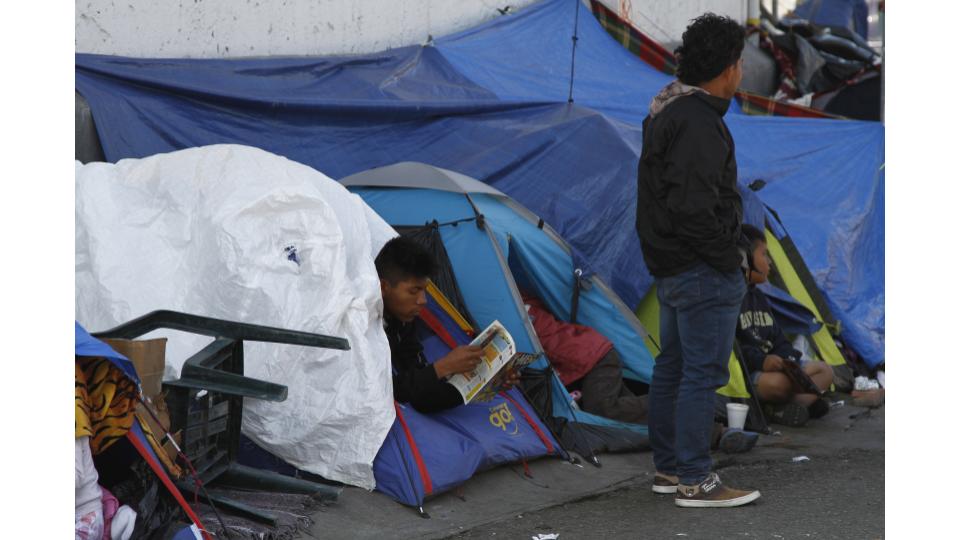
Other people cannot do this. I think in particular about the folks who are living in tents in Ciudad Juarez, on the U.S./Mexican border. I live in Wisconsin, so I expect to be cold for most of the year. The street people who stay near the ports of entry in Mexico have no understanding of cold weather. They all come from tropical climates. They are totally unprepared to live in a tent when the temperature dips down to 39 degrees (as it will tonight). These migrants do not have warm clothes, nor do they have a warm shelter.

I will grant you that their situation is not nearly as extreme as homeless people in Milwaukee. During the winter, our temperatures dive down into the minus teens, or lower. We have life-threatening cold in our city. People die here from the cold. On the other hand, we are all used to this sort of climate. The people who are stranded in Juarez have no clue. They don’t know how to adapt.

So, what will these people do? They don’t have warm clothes to survive through a cold winter. They don’t even have the money to buy the clothes that they would need to make it. Do they stay and freeze in the dark? Do they leave and return to Central America, where they can be murdered by the gangs in a warmer climate? What do they do?

I am very aware that I have it made. I have a nice house, with heat. I have a full refrigerator. I do not fear a knock at the door in the middle of the night. I live a life that most of the people in the tents would envy.  I know that.

I lack only a clear conscience.

I wish that I could save these migrants. Alone, I can’t.

I can do a few things to help. Maybe I can do more. I don’t know.

I will do whatever I can, and ask God to do the rest.


You Don’t Belong Here

October 30th, 2019

Ruben Garcia is an impressive man. He has been running Annunciation House (parent organization for Casa Vides, Casa Romero, and Casa de Refugiado in El Paso) for over forty years, so he knows what he’s doing. Ruben sat with our group at a table in the Café Mayapan. He ordered himself an avocado salad, and stared at us for a moment. Then he asked us why we had come from Wisconsin to participate in the Border Awareness Experience. I’m not sure what answers we gave to him, but he did not seem to be impressed.

Ruben responded to us like this:

“YOU DON’T BELONG HERE! You don’t belong on the border! You belong back home in Wisconsin! You let Trump get elected! Why didn’t you do your homework? You need to go home and make sure that Trump, and Pence, get impeached! Failing that, you need to make sure that they do not get re-elected!”

Okay, we love you too.

From there, Ruben launched into a rant. It was a passionate, intelligent sort of rant. He knew his stuff, and he knew how drive home his point.

He told us, “Things here are BAD!”

Like really bad. Like they have never, ever been this bad before.

I was mildly irritated. Having served in the Army, I have been yelled at by professionals. Yeah, I guess we were all just ignorant tourists, but we were trying to do the right thing.

I spoke to Ruben, “Okay, so, I was initially a little shocked by what you said, but you’re right: we don’t belong here. I figured that out when I pulled into the driveway at Casa Vides. However, I had to come here in order to know that I don’t belong here.”

He smiled faintly. He said, “I am sure you all know that what I meant was that you all have work to do back home.”

Yeah.

Ruben had many other things to say to us (in a calmer voice). He spoke about our country’s responsibility to the migrants. Our country keeps the drug trade going. Forty billion dollars a year flows from us to Mexico to pay for illegal drugs. That money pays for a lot of corruption and violence, in Mexico and throughout the rest of Latin America. Our insatiable hunger for drugs has caused this humanitarian disaster.

Ruben gave examples of families fleeing from the gangs and the cartels. Someone asked him if it would help if we told people back home about the personal stories of migrant families. Ruben didn’t think that would necessarily help. He said,

“Justice has to stand on its own feet.”

I think he meant that the abuse of migrants by our government is obvious. Our complicity in their suffering is obvious. If people can’t see all that, then telling them a sob story about a poor migrant family won’t change their minds.

Ruben told us that we shouldn’t have a War on Drugs. We need a War on Addiction. The Border Patrol and the Wall won’t stop the flow of drugs to the north. The market is too big and too lucrative. Ruben said that the emphasis has to be on helping addicts and reducing consumption. If people in America stopped buying smack, coke, and meth, then there would be no market, and there would be no cartels.

Eventually, the discussion ended. we had to go somewhere else to listen to somebody else.

When we left, I noticed that Ruben had barely touched his avocado salad.


Hospitality

October 30th, 2019

“By definition, a government has no conscience; sometimes it has a policy, but nothing more.” – Albert Camus

Sister Ann Catherine and I started our road trip to El Paso on October 16th. We drove, with only a few brief stops, from Milwaukee to Fort Smith, Arkansas. That was twelve solid hours of windshield time. We arrived at St. Scholastica Monastery tired and a little punchy; well, at least I was. Neither of us had ever been to this monastery before, so we looked around for somebody who might know where we were supposed to stay for the night. We stumbled into the convent, and I asked for Sister Kimberly. She was my contact person at the monastery.

Sister Kimberly burst into the room, followed by Sister Regina. Sister Kimberly is the interim administrator of the monastery. She is a tiny woman with a noticeable limp. She also has a brilliant smile, and a positive mood that is contagious. Sister Kimberly has an energy that makes her incandescent. She practically glows.

Sisters Kimberly and Regina asked us to meet across the street at their newly purchased guest house. We did that, and the two sisters showed us around. The guest house is a beautiful building with several bedrooms. Sister Ann Catherine found her space and I claimed mine.

Sister Kimberly gave us a key to the guest house, and she gave us a spare key to the convent, so that we could come to join the community for morning prayer and Mass the next day.

My thoughts turned to business. I asked her,

“Sooooo, when would you like us to pay you for our stay here? You know, for the rooms and for our meals with you all.”

Sister Kimberly smiled at me and said firmly, “You aren’t paying us anything.”

I shrugged and replied, “Okay, but we really should…”

She cut me off, “NO. We sent one of our sisters to the border recently. This is our way of  supporting your ministry.”

There really wasn’t much else to say.

Kimberly smiled again, and said, “See you at dinner!”

Sister Ann Catherine was amazed by all this. She told me,

“What hospitality! They give us the keys to the place, and then they refuse to take our money!”

It was pretty amazing, and it was totally cool. We were complete strangers to these religious sisters, but they trusted us and welcomed us with open arms.

Sister Ann Catherine and I learned about a very different kind of hospitality when we got to the El Paso and the southern border. We found out what kind of welcome migrants and asylum-seekers get from the government of the United States.

Under the guidance of President Trump, the Department of Homeland Security is doing literally everything it can to discourage migrants from coming to the United States. A migrant, arriving at a legal port of entry and seeking asylum in our country, is subjected to “metering” at the border, meaning they have to take number (like they were ordering something from a deli), and then wait to be called. The wait might take weeks or months. If a migrant has the patience and stamina to wait until their number is called, then they are subject to the “migrant protection protocols”, which require the person to remain in Mexico until their asylum case goes before an immigration court. That might mean that the migrant is stuck in Mexico for years. It also means that the migrant has little or no access to legal representation. If the migrant comes into the U.S. illegally (not at a port of entry) and tries to get asylum, they will most likely be held in a detention center (i.e. prison) for an indefinite amount of time.

Finally, it is extremely unlikely, when the migrant’s case finally goes before an immigration judge, that the individual will be allowed to remain in the United States. Immigration judges in the El Paso area have a denial rate of 95%. It is easier to win the lottery than it is to get asylum in the United States.

Do you see a pattern here?

The U.S. government, at this point in time, is doing everything it can to be inhospitable. As Dylan from the Hope Border Institute told us, the policy is all about “deterrence.”

The message to the migrants is: “Go away, and don’t come back.”

This message is problematic for migrants, many of whom are fleeing for their lives. They are often coming from Honduras, Guatamala, or El Salvador, where the gangs have threatened to kill them. These people can’t go home. It hard for them to stay in Mexico. They have no money, no jobs, and no friends in Mexico. Ciudad Juarez is a dangerous place to be. The city has ten murders a day.

The current immigration policy of the United States is cruel and cynical. It is also potentially deadly for these migrants.

It’s hard for me not to be angry as I write all this down. However, I know there are good people helping migrants on both sides of the border. At Casa Vides and at Casa Romero we saw migrants being welcomed. These people were given food, clothes, and shelter. Most of all, they are given love and respect.

They were shown hospitality.


A City Divided

October 28th, 2019

I went to Berlin once. That was back in 1982, and I was still in the Army. The Cold War was going strong, and the Wall still split Berlin into two halves. I only spent a couple days there. I stayed with a friend of a friend in West Berlin. I also managed to visit the Soviet sector. I went through Checkpoint Charlie. Needless to say, that was an interesting experience.

Last week I was with a group of Catholic migrant advocates in El Paso/Ciudad Juarez. We went across the border between the U.S. and Mexico four times during our visit. We saw the steel wall that divides the communities from each other. While I was there, I started thinking about Berlin, for the first time in a long time. I started to remember things.

El Paso and Juarez started out centuries ago as a single settlement, El Paso del Norte. Even now, after history and politics have separated the the population into two communities, El Paso and Juarez remain deeply connected. There is a constant movement of people and products across the international border. The economies and cultures of the two municipalities are intimately linked. El Paso and Juarez are still, in some respects, a single city, a home to 2.5 million people.

Chris took us to scenic lookout in the mountains on the northern edge of El Paso. From there we could view both El Paso and Ciudad Juarez. The Rio Grande snaked through the center of the urban sprawl. The wall was nearly invisible from our vantage point. To me it all looked like one big city. From a distance I could not see the separation, but I knew it was there.

We visited the Chamizal National Memorial in El Paso. The park is close to the Rio Grande and the Cordova Port of Entry. There is an international bridge that crosses the river. It is used for truck traffic. A line of semis stretched for miles from near the memorial all the way to the bridge. Truckers were waiting for hours to bring their goods into Mexico. The parade of vehicles was an obvious sign of the importance of trade between the U.S. and Mexico. Despite the wall and other barriers, the freight had to flow.

Other things flow across the border. Things like drugs and money. We were told that consumers of illegal drugs in the United States send $40 billion to Mexico annually. Drugs are produced in Mexico, or they flow through the country from other places. These drugs somehow find their way into the U.S. During our visit, our group spoke with members of the U.S. Border Patrol.

I asked one of them, “What percentage of the drug traffic do you think you stop?”

I did not get a straight answer. The officer told us that there was no way of accurately measuring the effectiveness of their interdiction efforts. In short, the Border Patrol has no idea how many drugs are entering the United States. They don’t know how much they are stopping. Apparently, they aren’t stopping enough drugs from coming north, if $40 billion are heading south every year. The money going into Mexico pays for many things: guns, bribes, all sorts of transportation. Walls don’t matter if you have plenty of cash.

So, what do the walls and all the other obstacles on the border between Juarez and El Paso actually stop? Trade, legal or otherwise, is seemingly not affected. Money and merchandise cross with only minor delays. However, people are prevented from coming into the U.S.. Migrants from Guatemala, El Salvador, and Honduras are stopped at the border and denied entry. I’ve seen their tents in the park near one of the ports of entry. Migrants from southern Mexico who are fleeing the violence of the cartels are stuck at the border too.  Why are all these people trapped on one side of a political boundary? It is because they are poor. That’s the bottom line. They have no money, so they have no power, and that makes them unwelcome in our country.

When I was at Checkpoint Charlie in Berlin all those years ago, I visited the museum there. All the exhibits in the place honored the courage and ingenuity of the East Germans who somehow found ways to flee to the West. No matter how much the East German regime tried to keep its citizens on their side of the Wall, a few people always found a path to a better life. I remember how, during the Cold War, we in the West celebrated the bravery of these migrants, and we mourned the those who died trying to cross the border.

For some reason we don’t feel the same way about the migrants trying to cross our border. A person who walks for two months from Guatemala, because he or she fears for their life, and then tries to find asylum in the U.S., is just as brave and motivated as a German fleeing Communist oppression. But we don’t see it that way. We think of the Germans that ran to the West as being heroes. We see the migrants huddled in Ciudad Juarez as being criminals.

Walls don’t work. There is no historical record of a wall halting the movement of people for a significant length of time. The Berlin Wall lasted less than thirty years. It did stop a lot of people, but not all of them. Desperate people can be very inventive and persistent. They will find a way to get to their destination, or they will die trying.

My wife is a German. She has a small piece of concrete sitting on our kitchen counter. It is a piece of the Berlin Wall. It is a souvenir of sorts. It is a physical reminder of the fate of all walls.

Someday, I want to have a chunk of the wall that divides El Paso from Juarez. I would that as a souvenir.


Anapra

October 29th, 2019

“I respect only poverty and great adventures of the mind; between the two there is only a society which is laughable.” – Albert Camus

“Poverty signifies completeness without superfluity, wholeness without luxury: A state of holiness.” – Eric Gill

Ciudad Juarez is a poor city by almost any standard. Anapra is a section of the city that makes the rest of Juarez look prosperous. Anapra is a colonia, a slum. It is a place where people struggle. Some of them work in maquiladoras, the factories that are owned by American companies. The people in these factories earn next to nothing. Think of it this way: my youngest son, Stefan, is an iron worker, and he earns more in an hour than these folks make in a week.

It was Sunday morning. Everybody in our group was going to Anapra to attend Mass at the Iglesia Corpus Christi. We went from Casa Vides in two vans. We all had our passports, and we rolled quickly across the border into Juarez. It’s relatively easy to cross into Mexico. Coming back into the U.S. is an entirely different story.

Juarez looked a bit ragged. It got more so as we drove into Anapra. The houses had metal grates over all of the windows and doors. I don’t think these were for decoration. Many of the homes seemed incomplete. Often walls made of cinder blocks stood naked with steel rods sticking out of them. The rebar extended up above the walls, as if the intention was to build a second story on the house. I never saw anybody doing any construction, but then again it was a Sunday morning. I had the impression that work on these houses had ceased for some reason, maybe a lack of funds, or a lack of interest.

Some streets were paved, and others were just dirt. The dirt roads had major ruts and holes in them. Dust blew around in the wind. Dogs wandered aimlessly in the streets. I saw some chickens. Some of the properties looked well-maintained, and others were in various states of decay. Some houses were painted in bright colors. They had a beauty that was both simple and warm.

As we drove toward the church, we went down the main street in the neighborhood. We had to drive very slowly because the road was clogged with vendors. It looked like a garage sale of epic proportions. The rows of tents and umbrellas went on for blocks. It seemed like most of the merchandise was used. I didn’t notice many new things being sold. Many people were selling clothes or shoes. Some vendors had electronic products for sale. There was a little bit of everything there. One old man had spread a blanket on the ground, and he was selling hand tools that were rusty with age.

We arrived at Corpus Christi. We had time before the start of Mass, so we looked around. The church was simple and austere. It had the standard Catholic accoutrements: the crucifix behind the altar, the stations of the cross. There was a large shrine to Our Lady of Guadalupe. The church had no stain glass in the windows. There were pews in the front, and folding chairs in the rear of the church. At some point work had been done in the church and, like some of the houses I saw, the project wasn’t finished. Corpus Christi had a totally working class feel to it.

The Mass was a celebration, as it should be. The church was full of people who clearly wanted to be there. Music was supplied by two men, one with a guitar and the other with an electric bass. There was a level of enthusiasm that I seldom see in churches. People sang, clapped, and even danced. Families worshiped together, and the kids participated willingly. The liturgy was vibrant and alive. It was joyful.

I am certain that nearly everybody at that Mass was poor. Everyone I met in the church was friendly and welcoming. They were glad that our group was there with them.

We were glad to too.


Si Me Matan

October 28th, 2019

Casa Vides is hard to find. After an eleven hour drive (mostly on I-10), the three of us arrived in El Paso, Texas. Well, we kind of arrived there. The GPS got us pretty close to our destination. We had to wander around a bit to find the actual house. Casa Vides doesn’t have a big sign to advertise its location. If anything, it tries to stay hidden.

Leon Street has limited parking. When you come right down to it, there is really no parking on that street. I planted my Ford Focus in somebody’s private parking space, and then begged the owner to let me stay there for five minutes. It helped to have Sister Ann Catherine with me when I made my plea. People tend to be a bit more tolerant when a religious sister is involved in the conversation.

After parking the car, I led Sister Ann Catherine and Shawn in the wrong direction. I do that sort of thing. We turned ourselves around and found Casa Vides. It’s a two story brick building with an intentionally nondescript wooden door. The door simply says,”325″.  We rang the bell. Somebody answered.

That somebody was Gustavo. He was a slight, young Latino, with long hair and eyes like Jesus. He welcomed us in. Other people were there. Sister Caroline was on the phone, dealing with a crisis. Apparently, a young migrant woman was trying to fly to New York in order to be with her family. That was not going to happen because the airline refused to take her, due to the fact that she was in a wheelchair and she had nobody to assist her during the flight. The young woman had broken both ankles while crossing the Rio Grande in order to get to the United States from Mexico. The situation was turning into a mess, and Sister Caroline was trying to handle it.

The lower level of Casa Vides is split into two halves. One part is set up for people to sit and relax. There are several old, overstuffed sofas covered with cracking and crumbling Naugahyde. The other half of the first floor is set up as a dining area, with folding tables and folding chairs. In the back is a kitchen, and there is also the Romero Room, a bedroom with bunk beds for children.

The upper level has bedrooms, bathrooms, and showers. The bedrooms are set up to shelter migrants, and to house the volunteers at Casa Vides. To get to the upper level a person has to use an outside staircase. Seeing as El Paso generally has fair weather, this is not a problem. I wound up sharing a small room with four other men. This was not an issue for me. I grew up with six younger brothers. I have experience with this sort of thing.

How can I adequately describe Casa Vides?

First, Casa Vides is a home, albeit a temporary one. I felt at home there, even though I was a total stranger. I felt like I belonged there. That is a rare experience for me. I almost never feel like I belong.

There is a mural inside of Casa Vides. It shows the images of Gabriel and Gladys Vides. They were a married couple from El Salvador. Both of them were murdered by the death squads in that country. They were murdered by people who most likely trained by the U.S. at Fort Benning in the School of the Americas (SOA). The children of Gabriel and Gladys came to the U.S. and were eventually granted asylum. Those kids were in this house. They were at Casa Vides.

On the mural is a quote from Saint Oscar Romero, It says,

“Si me matan, resucitaré en mi pueblo.”

“If you kill me, I will be resurrected in my people.”

Flowing from the mural are streams of names on the walls. There are thousands and thousands of names on the walls. These are the names of people who were murdered in El Salvador and Honduras and Guatemala, and God only knows where else. In the basement are more names. Those are the names of the people who died trying to enter the U.S. from other countries. Many of the names are unknown because bodies were found in the desert. For those unknown dead, it is simply written, “Desconodido.” That Spanish word is everywhere in Casa Vides.

There is also a mural in the basement. It is tribute to a young man named Juan Patricio. Juan Patricio was not documented. He was staying at Casa Vides. The Border Patrol came for him. He ran. They killed him, not far from the house. They killed him because he was “illegal”, whatever that means. Juan Patricio is a martyr. He is a saint.

In the very early morning, I often sat in the dining area, and I read the names of the people on the walls.

I was surrounded by a cloud of witnesses. I was surrounded by saints.

I was never alone.


Walmart Memorial

October 27th, 2019

Chris took us all to the memorial of the Walmart shooting in El Paso. He drove us there in the van late in the afternoon. It was kind of surreal. The memorial is right next to Hooters, which was clearly open for business. Cops have closed off the street, but everywhere else life and commerce go on uninterrupted.

The memorial is huge. Just huge. It extends for almost a city block. It is simultaneously sacred and tacky. I guess that is a lot like life in general. There is an endless array of plastic flowers, stuffed animals, and Bible quotes. Votive lights and other candles are everywhere. There are a variety of flags flying: Israeli, Kuwaiti, German, British, Japanese, and Mexican. There are many Mexican flags. One flag is an amalgam of of the American flag and the Mexican flag. That one I liked.

The place also has many random notes. There are posters with quotes from St. Teresa of Calcutta. People from Colorado, Ohio, Puerto Rico, San Diego, Pittsburgh, Alabama, Utah, San Antonio, Tijuana, and even Nicaragua have left messages. There is a poster on the fence from the 82nd Airborne at Fort Bragg in North Carolina. The hopes and prayers are endless.

But, what does it all mean?

When people say that they are sending you their “thoughts and prayers”, that usually means that they aren’t going to do anything to help. That is the standard translation.

This is not to say that people don’t care. They do care. They simply do not know what to do. This is a problem.

I was very disturbed by my time at the memorial. I am sure that everyone else was disturbed too. We were all torn apart in some way. We recognized the hurt, and we were all wounded in turn. It was good that we went to Walmart, but we left that place damaged.

When we got back to Casa Vides, we wandered into the basement for a period of reflection.

That kind of sucked.

Being who I am, I chose to speak my piece during the reflection. This was probably unwise.

I don’t remember if I was the first to speak during the reflection, and it really that doesn’t matter.

I said that it bothered me that we prayed for the victims and their families, but we never bothered to pray for the shooter and his family.

I am the father of a killer. I know how this feels. Granted, Hans did what he had to do to survive in Iraq, but he still killed people. I think that I might understand how the parents of this Walmart murderer, this idiot, feel. I know the pain and the guilt. These parents are in agony, and they cannot fix anything.

I need to pray for the shooter. I need to pray for his family. The members of his family also qualify as victims.

I pray for Hans. He killed people, and he is convinced that he can never be forgiven.

When I was with our group in the basement, I asked about the shooter,

“Is this guy damned? Is he beyond redemption? Shouldn’t we pray for him? I’m just asking.”

The response was noncommittal. Some of the group could not pray for a killer.

I understand that. I wouldn’t pray for Hans either, except that I love him.

As a final note, Chris mentioned that there were 22 deaths at the Walmart shooting in El Paso. El Paso’s sister city, Ciudad Juarez, has ten murders every day.

Just sayin’.